Written By:
GreenJams
9 min
Stubble Burning in India: Can Crop Waste Become a Building Material?

Every October and November, smoke from burning paddy fields in Punjab and Haryana drifts across North India. Farmers have weeks, sometimes days, to clear rice straw before sowing wheat, and a matchstick is still the cheapest tool they have. The search for a stubble burning solution India can scale has focused on machines, subsidies and penalties. Those measures are working, but they treat straw as a waste to get rid of rather than a raw material worth paying for.
This article looks at a different question: can crop residue become a building material? We explain why stubble is burnt, what agricultural waste building materials already exist, how paddy straw construction products are made, and the practical hurdles of collection, processing and performance that decide whether the idea works at scale.
Tags:
Sustainability
Why Do Farmers Burn Stubble in India?
Stubble burning is not a habit of careless farmers. It is a rational response to a tight calendar and thin margins.
A narrow window between two crops
In the rice–wheat belt of Punjab and Haryana, paddy is harvested in October and wheat must go in by November to protect yields. Combine harvesters leave long, loose straw on the field. Clearing it by hand or machine takes time, labour and diesel. Burning takes an afternoon.
The scale of the residue
The volumes are large. An ICAR newsletter (October–December 2017) estimated that about 23 million tonnes of paddy straw were burnt in the fields of Punjab and Haryana, and that field burning causes losses of roughly 32–76% of the straw's weight and 27–73% of its nitrogen. That is organic matter and nutrients going up in smoke, along with the particulate pollution that worsens winter air quality across the Indo-Gangetic plain.
Paddy straw is a poor fodder
Wheat straw has a ready market as cattle feed. Rice straw is less popular because of its high silica content, which makes it harder to digest. With weak local demand, farmers have little reason to collect and store it.
Penalties and machines have helped
Enforcement, subsidised in-situ machinery and coordination by the Commission for Air Quality Management (CAQM) are making a difference. In December 2025, the Union Environment Minister told the Lok Sabha that Punjab and Haryana recorded about 90% fewer farm fire incidents in the 2025 paddy season than in 2022. That progress is real. But fewer fires is not the same as a lasting use for the straw. As long as residue has no buyer, the incentive to burn returns whenever enforcement slips or the weather tightens the sowing window.

The Stubble Burning Solution India Needs: A Market for Straw
There is no single answer to the question "what is the solution to stubble burning?" India uses two broad families of options, and each has a role.
In-situ management: keep the straw in the field
Machines such as the Happy Seeder and Super Seeder sow wheat directly into the stubble or mix straw into the soil. Bio-decomposer sprays developed by IARI break residue down in the field. These approaches return organic matter to the soil and avoid transport costs. Their limits are cost, machine availability during a short peak season, and farmer confidence in yields.
Ex-situ management: take the straw out and use it
Ex-situ options bale the straw and send it to an industrial user: biomass power plants, co-firing in thermal plants, compressed biogas, pellets, packaging, and building materials. In July 2023 the Ministry of Agriculture and Farmers Welfare revised its Crop Residue Management guidelines to support paddy straw supply chains in Punjab, Haryana, Uttar Pradesh and Delhi. Under the scheme, the Centre and states fund 65% of the project cost, the industry promoter 25% and the farmer-side aggregator 10%. The plan envisages about 333 projects of 4,500 tonnes a year each, collecting an estimated 1.5 million tonnes of straw over three years.
Why demand matters more than disposal
Ex-situ capacity is still small compared with the problem. A CEEW study on ex-situ crop residue management found that ex-situ utilisation in Punjab has stayed below 1 million tonnes, less than 6% of the paddy residue the state generates. The gap is not a shortage of straw. It is a shortage of reliable, paying demand.
This is where construction comes in. India is building homes, schools, factories and infrastructure at a pace that needs huge volumes of walling material every year. If even a small share of that demand used agricultural waste as a raw material, straw would gain a price. And a straw with a price is a straw that farmers collect rather than burn.

How Paddy Straw Construction Materials Are Made
Agricultural waste building materials are not a single product. They cover a family of technologies that use crop residue as a fibre, a filler, or a source of minerals, and each one offers a different route away from stubble burning.
What is inside paddy straw?
Rice straw is a lignocellulosic material: mainly cellulose, hemicellulose and lignin, with a notable share of silica taken up from the soil. Peer-reviewed research in BioResources (2024) describes how that silica interacts with the plant fibres and tests rice straw as a filler in gypsum boards. The same properties that make paddy straw a poor fodder, its toughness and mineral content, can be useful in a composite.
Main product types
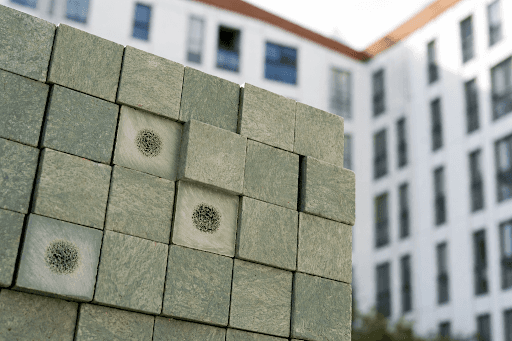
Bio-bricks and blocks: chopped straw mixed with a mineral binder such as lime or a low-carbon cement alternative, then pressed or cast and cured without kiln firing.
Boards and panels: straw fibres bonded under heat and pressure for partitions, ceilings, doors and furniture.
Fillers and ash: straw or its ash used in place of part of the sand or cement in mortars and blocks.
Can paddy straw be used to make bricks?
Yes, though not on its own. Straw provides bulk, fibre and stored biogenic carbon; a binder provides strength and durability. Because these blocks are cured rather than fired, they avoid the coal or biomass fuel that a traditional clay brick kiln burns.
Where the carbon goes
Plants absorb carbon dioxide as they grow. When straw is burnt, that carbon goes straight back to the atmosphere, along with smoke and soot. When straw is locked inside a wall that lasts decades, much of that carbon stays out of the air for the life of the building. Combine that with a binder that has lower emissions than ordinary cement, and a block can, in some cases, store more carbon than its production releases. Whether a specific product achieves this must be shown by a lifecycle assessment, ideally a third-party-verified Environmental Product Declaration (EPD). Our guide to embodied carbon in buildings explains how to read these numbers.

The Hard Parts: Collection, Processing and Performance
Turning stubble into a wall is possible. Doing it reliably, at scale and at a fair price is the real test. For construction to count as a genuine stubble burning solution in India, it has to clear three hurdles.
1. Collection and logistics
Paddy straw is bulky and light, so it is expensive to move. The harvest arrives all at once, so balers, tractors and labour face a short, intense peak. Straw must then be stored dry for months to feed a factory all year. Small, scattered landholdings add to the complexity. This is why aggregators, farmer producer organisations and biomass depots, of the kind the revised CRM guidelines fund, matter as much as the factory itself.
2. Processing and consistency
Straw quality varies with variety, moisture, soil contamination and how it was harvested. Manufacturers need consistent inputs to make consistent products, so straw is typically cleaned, dried, chopped to size and sometimes pre-treated. Each step adds energy and cost, which must be counted in the product's carbon footprint and price.
3. Material performance
A building material must do its job before it does anything else. Buyers rightly ask:
Strength: does it meet the compressive strength the design needs?
Moisture and durability: how does it behave in monsoon rain, humidity and termite-prone areas?
Fire: how does an organic-content product perform in a fire test?
Standards and approvals: has it been tested against the relevant Indian Standards and accepted by the approving authority?
Is building material from agricultural waste strong enough?
It depends on the product, not on the raw material. Some straw-based panels are designed only for non-load-bearing uses such as partitions and ceilings. Some straw-and-binder blocks are tested for masonry walling. Treat every product on its own test data: ask for lab reports, the standard tested against, and the intended application. No agricultural-waste product, including ours, should be assumed suitable for every structural use without project-specific engineering validation.
Cost and the right comparison
Straw-based products compete with fly ash bricks, AAC blocks and fired clay bricks that have mature supply chains. Compare the installed cost of the whole wall, including mortar, plaster, labour and speed of construction, rather than the price of one block. Our comparison of AAC blocks, red bricks and Agrocrete® walks through that method.

From Stubble to Structure: What You Can Do Now
No single technology will end stubble burning. In-situ machines, enforcement, crop diversification and ex-situ industries all have a part to play. But a durable stubble burning solution India can rely on year after year needs one thing above all: steady demand that turns straw into income. Construction is one of the few sectors large enough to create that demand.
For architects and builders
Ask suppliers for a third-party-verified EPD, not just a "green" label.
Check test reports against the relevant Indian Standards for your intended use.
Start with one element, such as non-load-bearing infill walls, and measure the results.
Frequently asked questions
What are the alternatives to stubble burning? In-situ options such as Happy Seeders, Super Seeders and bio-decomposers, and ex-situ uses such as biomass power, compressed biogas, pellets, packaging and building materials.
Does using straw in buildings really cut emissions? It can, because the straw is not burnt and part of its biogenic carbon stays locked in the wall. The net effect depends on the binder, processing energy and transport, so rely on a verified lifecycle assessment.
Will farmers get paid for straw? That is the goal of ex-situ supply chains. Prices depend on local demand, distance and aggregation arrangements, which vary by district and season.
How GreenJams puts this into practice
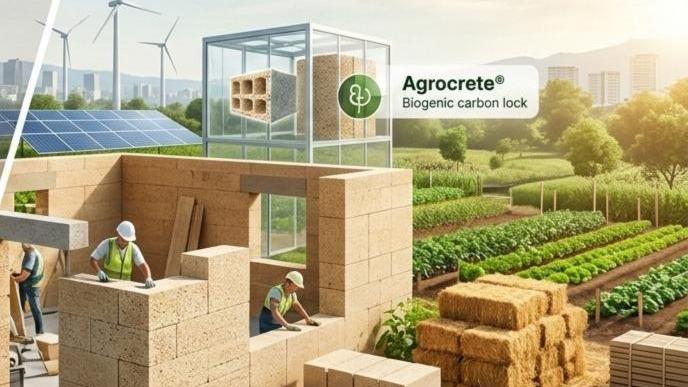
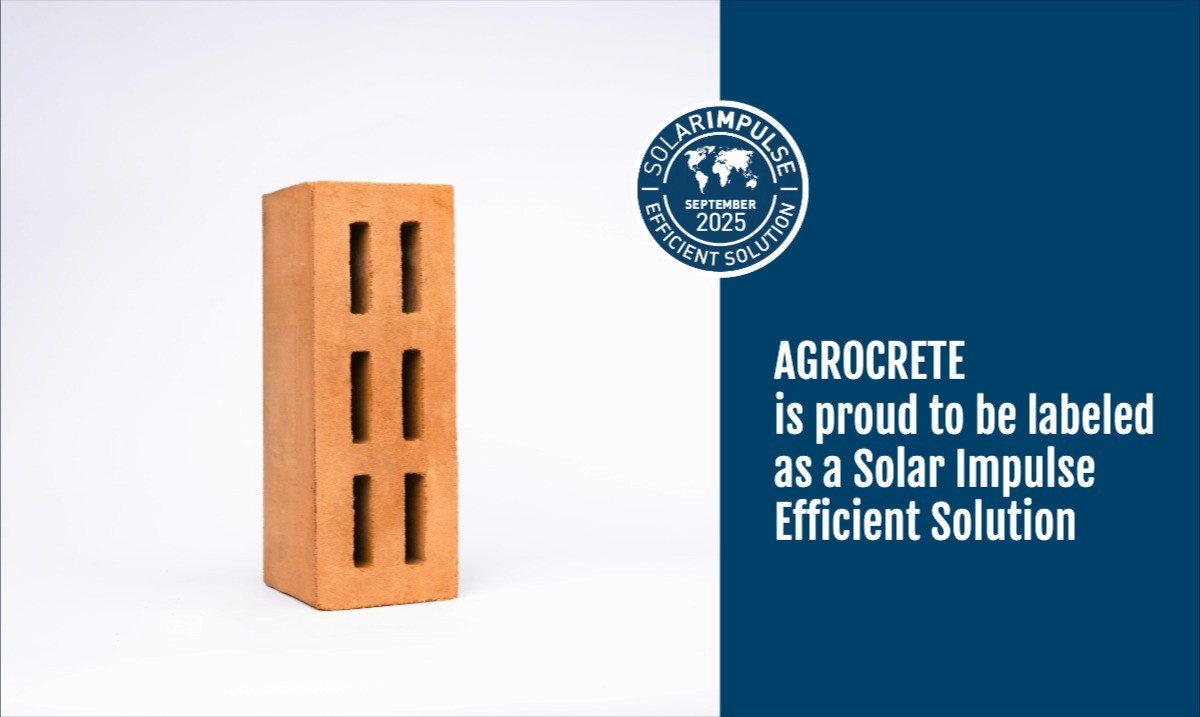
GreenJams makes Agrocrete®, a walling block made from agricultural residues such as paddy straw, together with industrial by-products. Agrocrete® is carbon-negative per its third-party-verified EPD; our catalogue lists a manufacturer-declared footprint of −0.14 kgCO₂e per kg. Read how we earned the world's first verified carbon-negative construction block status. Performance and carbon outcomes vary by project and need project-specific validation, so talk to our team about your application.
Ready to build with crop waste instead of burning it? Discover Agrocrete® and explore the product range.

Related posts
•
10 min
Read more
Sustainability
How Cement Contributes to Global Warming: The Construction Industry's Carbon Challenge
Cement carbon emissions explained: why clinker drives about 8% of global CO₂, what it means for India, and which low-carbon binders can help.

•
11 min
Read more
Sustainability
What Is Embodied Carbon in Buildings? A Practical Guide for India
What is embodied carbon in buildings? See how it differs from operational carbon, and how material choices in India cut upfront emissions. Start here.

•
4 min
Read more
Sustainability
Stone to Carbon-Negative: A History of Building Materials
A short history of building materials, from stone and timber to concrete, and the sustainable construction materials that now store more carbon.
 Agrocrete® Blocks