Written By:
Tarun Jami
4 min
Stone to Carbon-Negative: A History of Building Materials
Every era of civilisation is written in its buildings. Stone defined permanence. Timber defined craft. Concrete defined modernity. Each material revolution expanded what humanity could build, and quietly reshaped our relationship with the planet. This short history of building materials traces that journey, from earth and lime to the sustainable construction materials now emerging in India.
Tags:
Sustainability
The Turning Point: A History of Construction Materials & Climate Impact
Today we are entering the first era in which construction must answer not only to engineering limits, but to ecological ones, informed by climate science, life-cycle analysis and material chemistry. Buildings and construction now account for around 37% of global CO₂ emissions, according to the UNEP and GlobalABC Global Status Report 2025–2026.
Sustainable building materials are redefining how buildings respond to climate impact, and some can now store more carbon than they emit.
The Age of Natural Balance
For most of human history, construction was unintentionally sustainable. Buildings relied on local materials: earth, lime, timber and stone. Transport energy was minimal. Processing temperatures were low. Structures weathered and returned to the soil without a toxic legacy.
This balance was not intentional sustainability. It was the result of technological and energy constraints. Energy was scarce, supply chains were short and industrial scale did not exist. As a result, the climate footprint of construction remained small. Humanity built within ecological limits because it had no choice.
The Industrial Revolution removed those limits. To understand where we are headed, it helps to revisit India’s indigenous building heritage and what it teaches about sustainability.
The Concrete Century and Cement’s Carbon Emissions
The invention of Portland cement in the 1800s unlocked a new architectural language. Concrete enabled skyscrapers, megacities, highways and infrastructure at a planetary scale, and it became one of the most consumed manufactured materials on Earth. According to Chatham House, more than 4 billion tonnes of cement are now produced every year.
But cement carries a chemical burden. Making clinker, its key ingredient, means heating limestone until it gives off CO₂, on top of the emissions from burning fuel in the kiln. Chatham House estimates that cement accounts for around 8% of global CO₂ emissions, and that more than half of those emissions come from the clinker process itself rather than from energy use.
For over a century, construction optimised for durability and speed while treating carbon as an invisible externality. The atmosphere absorbed the cost. Climate science has since revealed the scale of that debt. What cement enabled at scale, the climate is now forcing us to reconsider at scale. We are now in a material reckoning.
The Rise of Sustainable Chemistry
The 21st century marks a fundamental shift: we are redesigning construction at the molecular level. Instead of only asking how to use less cement, researchers began asking how to replace it. Industrial by-products such as steel slag and fly ash, along with agricultural residues, are being turned into binders and structural materials. Waste streams are becoming feedstocks, and chemistry is becoming a climate strategy.
Sustainable chemistry means designing binders and materials whose fundamental reactions reduce emissions instead of generating them. This shift is central to sustainable construction materials that cut embodied carbon. Chatham House’s Making Concrete Change report identifies clinker substitutes and novel cements as key levers for the sector.
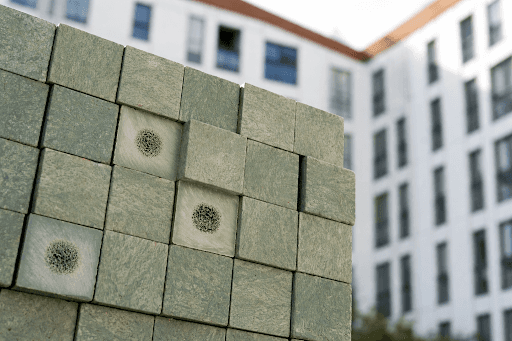
This is where carbon-negative materials emerge. Agrocrete® blocks represent a new class of masonry. Made from paddy straw, fly ash and a cement-free binder, they store more carbon than their production emits. Their third-party verified EPD puts the footprint at about −0.14 kgCO₂e per kg, cradle to gate, and the GreenJams product catalogue rates them at 3.5 times the thermal insulation of conventional walls.
The binder behind this shift is BINDR™, an alkali-activated binder made from over 90% recycled industrial by-products. Per the catalogue, it carries about 80% lower embodied carbon than ordinary Portland cement (0.18 vs 0.80–0.90 kgCO₂/kg) and reaches 45–47 MPa at 28 days, comparable to OPC 53 grade, so mortars and blocks can meet structural demands without inheriting cement’s climate burden. These are not experimental curiosities. They signal sustainable chemistry becoming a construction baseline.
A New Material Era
For the first time in history, buildings can act as carbon sinks, and the built environment can move from emitter to absorber. That shift is as significant as the invention of concrete itself. In Goa, Aadi Villa, a 10,000 sq ft load-bearing family home, was built from 60,000 blocks pressed on site from local soil, sawdust and BINDR™, with no steel and no conventional cement. It locks away 45 tons of CO₂.
Future historians may describe this moment as the turning point when construction stopped extracting from the planet and began repairing it. The materials we adopt today will decide whether cities become climate liabilities or climate infrastructure. Every previous era was built for strength. This era must be built for survival, and survival, now, is a material science question.
Just as concrete once defined modernity, sustainable chemistry will define resilience in the decades ahead. To see where this leads, read our explainer on climate-positive construction, or learn how materials drive a building’s footprint in our guide to embodied carbon in buildings.
Related posts
•
12 min
Read more
Sustainability
Sustainable Building Materials in India: 10 Alternatives to Conventional Construction
Sustainable building materials India builders can use today: 10 lower-carbon alternatives, where each fits, and what test data to ask for first.

•
10 min
Read more
Sustainability
How to Keep Your House Cool in Indian Summers Without Relying Only on AC
Keep house cool in summer, India-style: roof and wall insulation, shading, cross-ventilation and smart orientation. See which fixes to make first.

•
9 min
Read more
Sustainability
Stubble Burning in India: Can Crop Waste Become a Building Material?
Looking for a stubble burning solution India can scale? See how paddy straw can become a building material, and what still stands in the way.

 Agrocrete® spec sheet (PDF)