Written By:
Tarun Jami
4 min
Climate-Positive Construction: The Carbon Counter-Attack
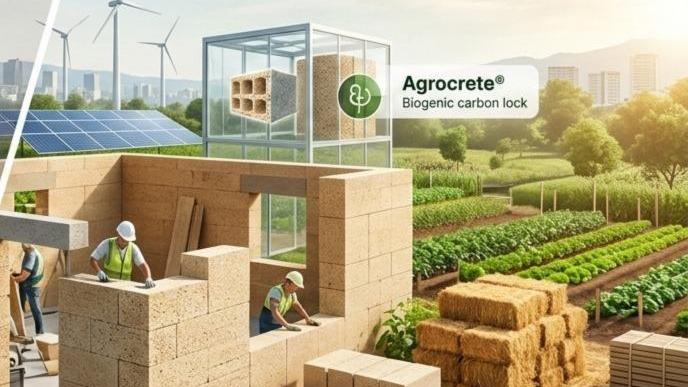
The climate crisis is no longer a distant threat. Heatwaves, floods and erratic monsoons are already reshaping how India lives and builds. Yet construction, one of the largest sources of emissions on the planet, still behaves like a passive bystander. At this scale of disruption, neutrality is not enough. The moment demands infrastructure that fights back, not infrastructure that fuels the fire.
This is where climate-positive construction becomes essential: infrastructure designed not just to reduce emissions, but to actively counter them.
Tags:
Carbon Capture
What Is Climate-Positive Construction?
Climate-positive construction means building in a way that removes and stores more carbon than the project emits across its life cycle. It goes a step beyond net zero, which balances emissions against removals, and carbon neutral, which usually relies on offsets. We compare the three side by side in climate-positive vs net zero: what’s the difference?
GreenJams is part of a new generation of construction innovators turning agricultural waste into climate infrastructure. The goal is not incremental improvement, but a systemic redesign of how buildings interact with the atmosphere: walls, blocks and binders that store carbon instead of releasing it.
Construction’s Carbon Burden
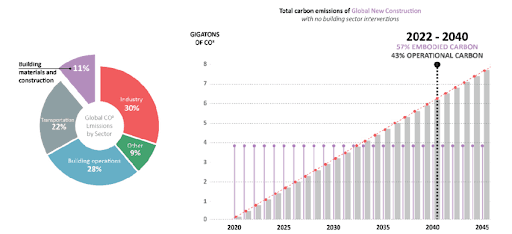
The scale is hard to overstate. The UNEP and GlobalABC Global Status Report for Buildings and Construction 2025–2026 finds that buildings and construction account for around 37% of global CO₂ emissions and nearly 50% of global material extraction. Much of that footprint is locked in before anyone moves in, through the materials used to build.
Traditional construction materials are the enemy within. Cement alone accounts for around 8% of global CO₂ emissions, according to Chatham House, and steelmaking adds a large share more. Embodied carbon is no longer a technical footnote buried in sustainability reports. Our guide to embodied carbon in buildings in India explains how it is measured and cut.
In India, where rapid urbanisation collides with intensifying heatwaves, floods and erratic monsoons, inertia is not just reckless. It is dangerous. The IEA’s India Energy Outlook 2021 projects residential floor space rising from under 20 billion to more than 50 billion square metres in about two decades. The construction choices made this decade will shape climate resilience for the next century.
Why Incremental Change Is Not Enough
Incremental efficiency improvements and surface-level greenwashing will not meet the moment. A building that merely emits less carbon is still locking damage into the system for decades. What is required is a decisive shift toward infrastructure that actively removes carbon from the atmosphere while meeting the world’s demand for housing and public infrastructure.
Bio-based materials and climate-positive construction
The assumption that climate-positive construction is experimental or fragile is outdated. Bio-based materials have been tested for fire safety, thermal performance and structural durability, and many insulate far better than conventional masonry, which cuts operational emissions while storing carbon. The barrier is no longer technological. It is cultural inertia.
This is where the counter-attack begins. Carbon-storing materials such as Agrocrete® solid blocks redefine what buildings can do. Made from paddy straw and other crop residue that would otherwise be burned, plus fly ash and BINDR™, a cement-free binder, Agrocrete® locks carbon inside the wall. Its third-party verified EPD reports about −0.14 kgCO₂e per kg, cradle to gate. Per the Agrocrete® catalogue, the blocks are CBRI-tested at 7.5–13 MPa across the range and rated for 4+ hours of fire resistance (manufacturer-declared).
Economic and supply chain advantages
The advantages compound economically. Agricultural residues are abundant and underused, which makes them a scalable feedstock rather than a scarce resource. Lighter, locally sourced materials reduce logistics costs, supply chain volatility and Scope 3 emissions. Meanwhile, ESG-linked finance and tightening carbon rules are shifting capital toward low-embodied-carbon projects. What appears radical today is likely to become standard procurement logic within a decade.
Case Study: A 2.6 km Climate-Positive Wall for ITC
This is already happening at industrial scale. After a 1.8 km pilot wall at Kapurthala, Punjab, ITC Ltd came back to GreenJams for a 2.6 km perimeter wall at Sandila, Uttar Pradesh. The project used 44,200 Agrocrete® solid blocks and took about seven months, from December 2022 to July 2023, built by crews using standard tools and mortar.
The Sandila wall stores 73 tons of CO₂ in its blockwork. Using crop residue that would otherwise be burned, and replacing conventional masonry, avoided a further 251.29 tons of emissions. Together, ITC’s two Agrocrete® walls run 4.4 km and store more than 110 tons of CO₂, delivered through boundary walls the company needed to build anyway.

The Future of Climate-Positive Infrastructure
The 2017 Global Status Report from GlobalABC and the IEA estimated that the world would build around 230 billion square metres of new floor area over the following 40 years, the equivalent of adding a city the size of Paris every week. The choice is stark: keep building with carbon as collateral damage, or engineer structures that store it. Construction must evolve from a sector of extraction into a sector of atmospheric repair.
Architects can specify carbon-storing materials. Developers can demand life-cycle carbon accounting backed by EPDs. Policymakers can reward climate-positive procurement. Communities can choose buildings that protect their future instead of borrowing against it. To see the science behind it, read how Agrocrete® stores carbon and the story of the world’s first verified carbon-negative construction block.
The tools already exist. What remains is the decision to use them. The counter-attack is underway, and the future will belong to those willing to build it. Get an Agrocrete® sample for your next project.

 Agrocrete® spec sheet (PDF)