Written By:
Tarun Jami
10 min
AAC Blocks vs Red Bricks vs Agrocrete®: Which Is Greener?
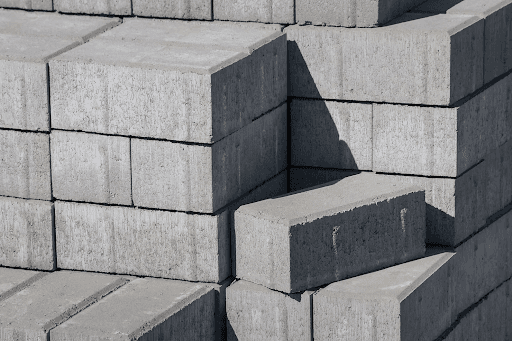
Are AAC blocks green? Compared with red bricks, mostly yes. They carry less embodied carbon per cubic metre, weigh about a third as much and insulate far better. But "greener than red brick" is a low bar. AAC is still made with cement, lime and steam, and the factory that makes it emits carbon.
This guide answers the questions people ask most often: is AAC eco-friendly, AAC vs red brick, which is better, and what are the disadvantages of AAC blocks. We compare AAC blocks, red bricks and Agrocrete® on carbon, insulation, weight, strength and cost, with a source for every figure.
Tags:
Sustainability
What AAC blocks are, and how they were invented
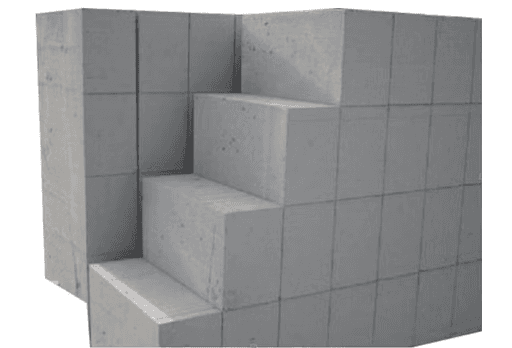
Autoclaved aerated concrete (AAC) is a lightweight precast masonry block. It is made from a slurry of fly ash or sand, lime, cement, gypsum and water, with a small dose of aluminium powder. The aluminium reacts with the alkaline mix to release hydrogen gas, which fills the slurry with tiny bubbles (Designing Buildings Wiki). The risen mass is cut into blocks and cured with high-pressure steam in an autoclave.
In India, AAC has become the default walling block for many developers because it is light, quick to lay and widely available, and some green-rating systems award points for using it. Those are real strengths. They also explain why so many homeowners now ask whether AAC is the eco-friendly choice for their own house.
An accidental invention
Aerated concrete is older than most people think. As early as 1889, a Czech inventor named Hoffman patented a way of aerating concrete with carbon dioxide (Designing Buildings Wiki). The breakthrough that made AAC practical came in Sweden in the 1920s, when builders were looking for alternatives to timber.
Johan Axel Eriksson, a Swedish architect working with Professor Henrik Kreüger at the Royal Institute of Technology in Stockholm, was experimenting with aerated mixes. As the story goes, he was short of time and put a sample in the laboratory autoclave to speed up curing. The porous block survived the steam and pressure, and came out stronger, with no shrinkage.
Eriksson patented the process in 1924, and production began at Yxhult in Sweden in 1929, according to the European Autoclaved Aerated Concrete Association. Today AAC is made by many companies across Europe and Asia. An accident in a Stockholm laboratory became one of the most widely used walling materials in the world.

Are AAC blocks green? Where their carbon comes from
It depends on your benchmark. Against burnt clay bricks, AAC is clearly greener. Against fly ash bricks, which in some regions are made almost entirely from recycled material with little processing energy, the case is weaker. Against a carbon-negative material, AAC is a step forward rather than a solution. (New to the term? Start with our guide to embodied carbon in buildings.)
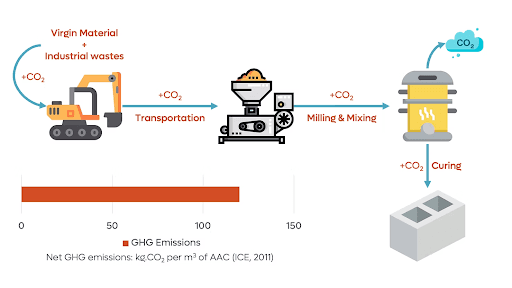
The reason lies in how AAC is made. The process has many steps, and several of them emit carbon. Lime and cement are the largest sources, because producing them releases CO₂ both from fuel and from heating limestone. Steam curing adds more. A 2019 life-cycle study of an AAC plant in China found that cement, lime and natural gas were the main materials behind its environmental impact (Shi et al., 2019).
How much carbon is in a cubic metre of AAC?
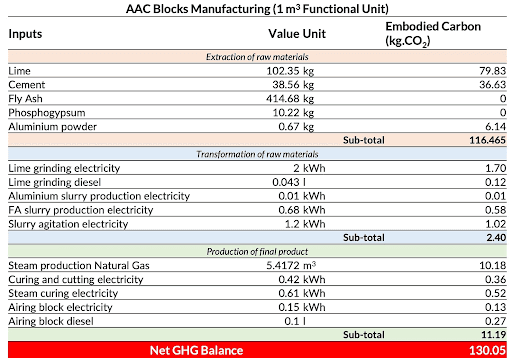
Using that plant's inventory and emission factors from the Inventory of Carbon and Energy (ICE) database, we estimate that making one cubic metre of AAC emits about 130 kg of CO₂ (the breakdown is shown in the next section). An independent cradle-to-gate study from Karnataka, published as a preprint in 2026, arrived at a very similar 125.86 kg CO₂e per cubic metre (Muneebhussain et al., 2026).
AAC is very light, at about 600 kg per cubic metre, so that works out to roughly 0.2 kg of CO₂ per kilogram of block. Per kilogram, AAC's footprint is therefore similar to, or even higher than, burnt clay brick's. Per cubic metre of wall it is much lower, because each block contains far less material.
Embodied energy tells a similar story
A 2024 study of affordable housing in Delhi put the embodied energy of AAC at 3.7 MJ/kg, against 6.5 MJ/kg for burnt clay brick and 0.83 MJ/kg for fly ash brick (Jain et al., 2024). The same study modelled a flat in Delhi's composite climate and found more hours of thermal discomfort with AAC walls than with brick, a reminder that insulation alone does not guarantee comfort. Shading, ventilation and roof design matter just as much; our guide to keeping your house cool in Indian summers explains how they work together.
AAC vs red brick vs Agrocrete®: the numbers side by side
The table compares the three materials on the measures buyers ask about most. Figures for AAC and red brick come from Indian Standards, a national test database of Indian walling materials and published studies. Agrocrete® figures come from its third-party verified EPD and from the GreenJams product catalogue, and are labelled manufacturer-declared where they have not been independently tested.
Measure | AAC blocks | Red (burnt clay) bricks | Agrocrete® |
|---|---|---|---|
Embodied carbon, cradle to gate | 126–130 kg CO₂e/m³ [1][2] | 199–355 kg CO₂e/m³ [3][1] | About −115 to −145 kg CO₂e/m³: EPD value of −0.143 kgCO₂e/kg [4] × manufacturer-declared density |
Dry density | 451–1,000 kg/m³ across grades [5]; tested samples 608–623 kg/m³ [6] | 1,264–2,119 kg/m³ in tested Indian samples [6] | 800–1,000 kg/m³ (manufacturer-declared) [7] |
Thermal conductivity | 0.21–0.42 W/m·K maximum, by density [5]; tested 0.17–0.19 W/m·K [6] | 0.38–1.12 W/m·K tested [6] | Not published (see U-value); declared 3.5× better insulation than conventional walls [7] |
U-value of a wall | About 0.70 W/m²K for a 200 mm wall [6] | 1.34–2.39 W/m²K for a 200 mm wall [6] | About 1.2 W/m²K or lower (manufacturer-declared; wall build not stated) [7] |
Compressive strength | 2.0–7.0 MPa minimum (Grade 1), by density [5]; tested 2.7–3.4 MPa [6] | Classes from 3.5 to 35 MPa [8]; tested 4.2–26.8 MPa [6] | 7.5–13 MPa across the range, CBRI-tested; 10+ MPa for Solid Bricks (manufacturer-declared) [7] |
Water absorption | 72–73% tested [6] | 20% maximum up to class 12.5 [8]; tested 7–32% [6] | 10–12% (manufacturer-declared) [7] |
Indicative cost | ₹3,500–4,000/m³, block only (AAC manufacturer) [9] | ₹5,176.50/m³, cradle to gate, in one Karnataka study [1] | No published price; ask for a laid-wall quote |
Sources:
Muneebhussain, Aravind and Kudachimath (2026), cradle-to-gate LCA and cost study, Karnataka (preprint).
GreenJams estimate using the plant inventory in Shi et al. (2019) and ICE emission factors.
Maithel (2023), Varanasi brick plant, as reported in TheAPN (2025).
Agrocrete® EPD S-P-06876, International EPD® System, valid to October 2027.
IS 2185 (Part 3):1984, Bureau of Indian Standards, Table 1.
Rawal, Maithel et al. (2020), National Database of Thermophysical Properties of Walling Materials, CEPT University and Greentech Knowledge Solutions.
GreenJams product catalogue and Agrocrete® catalogue page (manufacturer-declared, read October 2026), with the Agrocrete® Hollow Block and Solid Brick pages.
IS 1077:1992, Bureau of Indian Standards, common burnt clay building bricks.
Magicrete (2025), AAC block price guide.
What GreenJams' own catalogue says
GreenJams also publishes its own three-way comparison on the Agrocrete® catalogue page. We reproduce it here so you can see both views. All figures are as published by GreenJams, except Agrocrete®'s carbon figure, which is the EPD value (the catalogue table rounds it to −0.15).
Measure (GreenJams catalogue) | AAC blocks | Red bricks | Agrocrete® |
|---|---|---|---|
Embodied carbon | 0.24 kgCO₂/kg | 0.24 kgCO₂/kg | −0.14 kgCO₂e/kg (EPD) |
Compressive strength | 3–4 MPa | 5–7.5 MPa | 7.5–13 MPa (CBRI-tested) |
Water absorption | 10–15% | 18–20% | 10–12% |
Dry density | 550–650 kg/m³ | 1,800–2,000 kg/m³ | 800–1,000 kg/m³ |
U-value | 1.2–2.4 W/m²K | 3–4 W/m²K | ≤1.2 W/m²K |
Some rows agree with the independent data. AAC density and strength match the CEPT test results closely. Others do not. The catalogue gives AAC 10–15% water absorption, against 72–73% in CEPT's tests, and an AAC U-value of 1.2–2.4 W/m²K, against 0.70 measured for a 200 mm wall. Red brick's catalogue U-value (3–4) is also higher than the tested 1.34–2.39.
On carbon, the catalogue's 0.24 kgCO₂/kg for AAC is above the roughly 0.2 implied by the two AAC studies above. At catalogue density, red brick's 0.24 kgCO₂/kg works out to about 430–480 kg per m³, above the 199–355 range in the studies. The catalogue does not state wall thickness, test methods or sample sources, which probably explains much of the gap. Where the two disagree, we base our conclusions on the independent tests.
What the numbers show
Three things stand out. On carbon, AAC beats red brick by a wide margin per cubic metre, and Agrocrete® is the only one of the three that stores more carbon than its manufacture emits. On insulation, the independent tests put AAC ahead: its measured wall U-value is lower than Agrocrete®'s declared value and far lower than brick's. And AAC pays for its lightness with low strength and very high water absorption.
Cost is the hardest row to pin down. Prices vary by city and transport distance, and the sources measure different things: block only, or the block delivered to the gate. Treat these figures as a rough guide, and ask local suppliers for a laid price per square metre of finished wall, including mortar, plaster and labour.
AAC vs red brick: which is better for your build?
For most framed buildings, AAC is a better choice than red brick if your priorities are lower embodied carbon, lighter walls and better insulation. Red brick still has a place. It is stronger, copes better with moisture, is made in almost every district and suits load-bearing work and exposed finishes. Here is how the trade-offs play out on site.
Where AAC wins
Lower embodied carbon per cubic metre than burnt clay brick.
About a third of the weight, which reduces the load on the frame.
Much lower thermal conductivity, so less heat passes through the wall.
Large, accurately sized blocks that are quick to lay.
Disadvantages of AAC blocks
We have seen AAC's drawbacks first-hand at project sites, and quality teams at several large Indian developers have described the same problems to us. The blocks are very porous: tested Indian samples absorbed 72–73% of their weight in water, against 7–32% for burnt clay bricks (CEPT and Greentech, 2020). Repeated wetting and drying can cause cracking, and plaster can delaminate after a few years.
Strength is the other limit. Tested samples reached 2.7–3.4 MPa, so in Indian practice AAC is mostly used for non-load-bearing infill. Chases for concealed conduits must be cut accurately. Fixings need the right anchors, because a nail hammered straight in can shatter the block. Some builders add reinforced concrete bands at intervals in tall AAC walls to control cracking.
Where red brick wins
Burnt clay bricks are strong, with standard classes from 3.5 to 35 MPa under IS 1077, and they absorb far less water than AAC. They are made locally almost everywhere, and every mason knows how to lay them. Their weaknesses are carbon and heat. Kiln firing gives them the highest embodied carbon of the three, and their high conductivity lets heat straight through. We explore why traditional does not always mean sustainable in Are 'Natural' and 'Sustainable' the Same?
Where Agrocrete® fits, and how to choose
Agrocrete® was developed to close the gap that AAC leaves open. It is made from paddy straw, fly ash and BINDR™, a cement-free binder. Its third-party verified EPD shows a cradle-to-gate footprint of −0.143 kgCO₂e per kg, so each block stores more carbon than its manufacture emits. Our explainer on how Agrocrete® stores carbon covers the science and its limits.
On the other measures, Agrocrete® sits between AAC and red brick. GreenJams' declared figures make it heavier than AAC (800–1,000 kg/m³) but lighter than brick, stronger than AAC at 7.5–13 MPa, and far less absorbent than tested AAC. On insulation the evidence is split. Agrocrete® is declared at 3.5 times the insulation of conventional walls, but its declared U-value of about 1.2 W/m²K is higher than the 0.70 measured for AAC.
It also brings properties the tables leave out. Per the GreenJams product catalogue, Agrocrete® has 4 hr+ fire resistance, zero efflorescence and an exposed-grade finish that can be left unplastered, and it carries a 10-year warranty against cracks, dampness and termites (all manufacturer-declared).
The Agrocrete® Hollow Block is designed as an alternative to AAC for infill walls in framed buildings. In a mixed-use building in Vizianagaram, more than 3,000 hollow blocks were used on the two lower floors. The IT office there, which runs 20-hour shifts, reports electricity bills 60% lower, and the blockwork stores about 4 tonnes of CO₂.
How to choose
For the lowest carbon: choose a carbon-negative block with a verified EPD, such as Agrocrete®. Next come AAC and fly ash bricks, with burnt clay brick last.
For the best insulation: AAC leads on independent tests, then Agrocrete® on its declared U-value, with solid red brick last.
For load-bearing walls: use red brick or Agrocrete® Solid Blocks. Use AAC only where an engineer has designed for its strength grade.
For wet or exposed walls: avoid AAC unless plaster or cladding protects it well.
Every project is different, so ask any supplier for an EPD and test reports before you decide. To see GreenJams' full range of carbon-negative bricks and blocks, start with the Agrocrete® catalogue or order a sample.
Related posts
•
12 min
Read more
Sustainability
Sustainable Building Materials in India: 10 Alternatives to Conventional Construction
Sustainable building materials India builders can use today: 10 lower-carbon alternatives, where each fits, and what test data to ask for first.

•
10 min
Read more
Sustainability
How to Keep Your House Cool in Indian Summers Without Relying Only on AC
Keep house cool in summer, India-style: roof and wall insulation, shading, cross-ventilation and smart orientation. See which fixes to make first.

•
9 min
Read more
Sustainability
Stubble Burning in India: Can Crop Waste Become a Building Material?
Looking for a stubble burning solution India can scale? See how paddy straw can become a building material, and what still stands in the way.

 Agrocrete® spec sheet (PDF)