Written By:

GreenJams

5 min

Climate-Positive vs Net Zero: What’s the Difference?

Illustration of city buildings, wind turbines, solar panels and pine trees on a floating island of green land

Net zero, carbon neutral and climate-positive are often used as if they mean the same thing. They do not. Net zero is about balance, carbon neutral is usually about compensation, and climate-positive is about removing more carbon than you emit. For anyone specifying materials or setting a climate target for a building, the difference decides what you actually have to do.

This guide explains climate-positive vs net zero in plain terms, compares all three side by side, and shows how carbon-negative materials already make climate-positive buildings possible in India.

Tags:

Technology

Climate-Positive vs Net Zero vs Carbon Neutral

In simple terms: net zero means balance, carbon neutral means compensate, and climate-positive means remove. The IPCC’s AR6 glossary defines net zero CO₂ emissions as the point where human-caused emissions are balanced by human-caused removals over a set period. At a global scale it treats carbon neutrality as the same thing. For a company or product, carbon neutrality usually also counts offsets bought outside its own operations.


Net zero

Carbon neutral

Climate-positive

Definition

Emissions cut as far as possible, with the small remainder balanced by carbon removals

A footprint balanced to zero, usually through reductions plus offsets

More carbon removed and stored than emitted, leaving a net benefit

Scope

Usually a whole company or country, across its value chain, by a target year such as 2050

A defined subject, such as a product, building, event or company, over a set period

A material, building or project, measured over its life cycle

How it is achieved

Deep cuts first, then permanent removals for residual emissions

Measure, reduce, then offset what remains

Carbon-storing materials and removals that exceed all emissions, verified by an LCA or EPD

Example

A company with a science-based net-zero target

A product claiming neutrality under ISO 14068

A wall of carbon-negative blocks whose EPD shows net carbon storage

The Next Paradigm: Why Climate-Positive Is the Only Viable Standard

Today, the built environment stands at a crossroads. For decades, terms like net zero and carbon neutral dominated sustainability roadmaps. They marked progress and created accountability. But as the climate crisis accelerates, it is becoming clear that stabilisation alone is no longer enough.

The IPCC’s latest mitigation report is explicit: carbon dioxide removal to counterbalance hard-to-abate residual emissions is unavoidable if the world is to reach net zero CO₂ or greenhouse gas emissions. Buildings matter more than most sectors here. The UNEP and GlobalABC Global Status Report for Buildings and Construction 2025–2026 finds the sector accounts for around 37% of global CO₂ emissions and nearly half of global material extraction.

The next frontier is climate-positive infrastructure: buildings that go beyond balancing emissions and enable measurable carbon removal at the building and city scale.
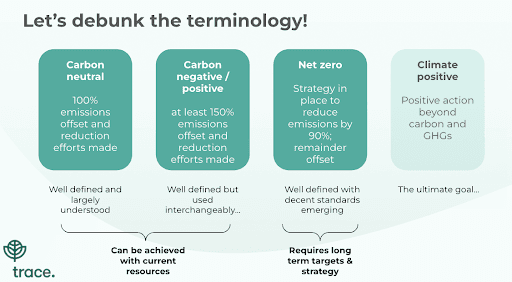
Trace chart comparing carbon neutral, carbon negative, net zero and climate positive, with what each requires

Why the Old Standards Fall Short

Net zero means balancing the greenhouse gases emitted with an equivalent amount removed from the atmosphere. Credible frameworks set a high bar. The SBTi Corporate Net-Zero Standard asks most companies to cut emissions by 90–95% before 2050 and to neutralise only the residual with permanent removals. In practice, many net-zero claims still lean on offsets or future removal promises without changing how materials are made.

Carbon neutral settles for balance rather than benefit. Under ISO 14068, the international standard for carbon neutrality, a product or organisation quantifies its footprint, reduces it and then offsets what remains. A project can claim zero net emissions over its life cycle while still generating emissions that are countered with credits rather than actual carbon drawdown.

Both frameworks are essential milestones. But neither inherently removes carbon at the scale the planet requires. They stabilise, pause and mitigate. What they do not yet do is reverse climate damage. That distinction matters: carbon-negative describes a measurable material footprint, while climate-positive describes the system-level outcome when those materials scale across entire buildings and cities.

From Less Bad to Net Good

A carbon-negative material removes more carbon dioxide from the atmosphere than it emits over its life cycle. This is not theoretical. It is quantifiable through life-cycle assessments and Environmental Product Declarations (EPDs), grounded in standardised carbon accounting. When carbon-negative materials are deployed at scale, infrastructure becomes climate-positive.

Take Agrocrete® carbon-negative blocks as an example. Unlike conventional masonry, which emits carbon through energy-intensive production, Agrocrete® is made from crop residue (paddy straw), fly ash and BINDR™, with no Portland cement. Its third-party verified EPD (S-P-06876) reports a cradle-to-gate footprint of about −0.14 kgCO₂e per kg, so each block stores more CO₂ than its production releases.

Paired with BINDR™, GreenJams’ low-carbon binder and mortar, the wall system shifts from neutral performance to measurable carbon storage. Per the GreenJams product catalogue, BINDR™ carries about 80% less embodied carbon than ordinary Portland cement (0.18 vs 0.80–0.90 kgCO₂/kg). In Gudivada, Andhra Pradesh, a 2,000 sq ft family home built with Agrocrete® stores 2.1 tons of CO₂ in its walls, and the family lives in it without air conditioning.

Climate-positive buildings can do more than store carbon. Better-insulated walls cut the energy needed for cooling (the catalogue rates Agrocrete® at 3.5 times the thermal insulation of conventional walls, manufacturer-declared), and putting crop residue to use instead of burning it helps reduce air pollution. For a deeper look at how material choices drive a building’s footprint, read our practical guide to embodied carbon in buildings in India.

Why Climate-Positive Must Become the Standard

The United Nations notes that keeping warming to 1.5°C requires emissions to fall by 45% from 2010 levels by 2030 and to reach net zero by 2050. Getting there, and pulling carbon back out of the atmosphere afterwards, depends on removals as well as cuts. Stabilisation is a necessary halfway point. Restoration is the long-term destination.

As embodied carbon accounting spreads and procurement standards tighten, carbon-storing materials are moving from innovation to requirement. Net zero bought us time. Climate-positive building can help buy us a future.

The Path Ahead

If sustainability evolves from damage control to climate restoration, every project becomes an opportunity, not just to build but to heal. With carbon-storing materials already in use on real sites, climate-positive infrastructure is no longer speculative. It is operational. The question is no longer whether climate-positive construction is possible, but how fast we are willing to adopt it.

To see what this looks like on the ground, read how climate-positive construction turns buildings into carbon stores, or request an Agrocrete® sample for your next project.
Suggested Blogs

Concrete frame building under construction in India with block and brick infill, cement bags and rebar on site

11 min

What Is Embodied Carbon in Buildings? A Practical Guide for India

Every building in India carries two carbon bills. One arrives slowly, as electricity for fans, lights and air-conditioning over 50 years or more. The other is paid in full before anyone moves in: the emissions from making, moving and assembling the cement, steel, bricks and glass. That second bill is embodied carbon in buildings, and it is the part most projects never measure.

This guide is for architects and specifiers who want a working understanding, not a lecture. It explains embodied versus operational carbon using materials you specify every week, shows why upfront emissions behave like a climate debt, and sets out how material selection can lower a building's upfront emissions without redesigning the whole project.

Tags:

Sustainability

Featured

Architect

Close-up of a wall of grey-green textured blocks, some with fibrous cores, in front of a white apartment building

4 min

Stone to Carbon-Negative: A History of Building Materials

Every era of civilisation is written in its buildings. Stone defined permanence. Timber defined craft. Concrete defined modernity. Each material revolution expanded what humanity could build, and quietly reshaped our relationship with the planet. This short history of building materials traces that journey, from earth and lime to the sustainable construction materials now emerging in India.

Tags:

Sustainability

Illustration of city buildings, wind turbines, solar panels and pine trees on a floating island of green land

5 min

Climate-Positive vs Net Zero: What’s the Difference?

Net zero, carbon neutral and climate-positive are often used as if they mean the same thing. They do not. Net zero is about balance, carbon neutral is usually about compensation, and climate-positive is about removing more carbon than you emit. For anyone specifying materials or setting a climate target for a building, the difference decides what you actually have to do.

This guide explains climate-positive vs net zero in plain terms, compares all three side by side, and shows how carbon-negative materials already make climate-positive buildings possible in India.

Tags:

Technology

Three grey hollow concrete blocks with rectangular cavities standing upright on a white background

4 min

The Circular Mandate: Circular Construction Future

Construction is one of the world’s most extractive industries. It consumes vast quantities of virgin raw materials while generating enormous volumes of waste. In a resource-limited world, the linear “take, make, discard” model no longer works. This article explains why circular construction, which turns industrial and agricultural waste into building materials, is fast becoming a necessity in India and beyond.

Tags:

Sustainability

Illustration of workers laying Agrocrete® blocks beside straw bales and farm fields, with solar panels and wind turbines

4 min

Climate-Positive Construction: The Carbon Counter-Attack

The climate crisis is no longer a distant threat. Heatwaves, floods and erratic monsoons are already reshaping how India lives and builds. Yet construction, one of the largest sources of emissions on the planet, still behaves like a passive bystander. At this scale of disruption, neutrality is not enough. The moment demands infrastructure that fights back, not infrastructure that fuels the fire.

This is where climate-positive construction becomes essential: infrastructure designed not just to reduce emissions, but to actively counter them.

Tags:

Carbon Capture

Agrocrete® hollow block beside the Solar Impulse label badge and text announcing the Efficient Solution label

3 min

Agrocrete® Earns the Solar Impulse Efficient Solution Label

FOR IMMEDIATE RELEASE

Tags:

Press & Media

3D render of Mivan aluminium wall formwork panels with steel reinforcement, set out for one floor of a building

10 min

Mivan Construction: Pros, Cons, Cost and Heat

Mivan construction is the name most Indian homebuyers and builders use for aluminium formwork: a system of reusable aluminium panels into which the walls and floor slabs of a building are cast in concrete, together, in a single pour. It has become one of the most common ways to build high-rise apartment towers in India because it is fast, repeatable and produces a strong, monolithic structure.

It also has trade-offs that rarely appear in a sales brochure, and the biggest of them is heat. This guide explains what Mivan technology is, how Mivan shuttering works on site, where it is used in India, its advantages and disadvantages, and what drives its cost and speed.

We then look at why Mivan flats can feel so hot in summer, and end with practical fixes and an honest account of where low-carbon walling such as Agrocrete® can, and cannot, fit in a Mivan project.

Tags:

Technology

Three grey hollow concrete blocks of different sizes standing upright on a white background

7 min

How Agrocrete® Stores Carbon: The Science Explained

Buildings and construction account for about 34% of global CO₂ emissions, according to the UN Environment Programme's Global Status Report 2024/2025. Cutting those emissions is essential. But the IPCC's special report on 1.5°C found that every pathway to 1.5°C with limited or no overshoot also relies on removing carbon dioxide from the air.

Agrocrete® is a building block designed to do a small part of that removal while it replaces high-carbon bricks and blocks. This explainer covers how crop residue stores carbon, why the product is carbon-negative within the boundaries its EPD declares, what the verified figures say, what they mean for a wall or a home, and where the limits lie.

Tags:

product

Suggested Blogs

Concrete frame building under construction in India with block and brick infill, cement bags and rebar on site

11 min

What Is Embodied Carbon in Buildings? A Practical Guide for India

Every building in India carries two carbon bills. One arrives slowly, as electricity for fans, lights and air-conditioning over 50 years or more. The other is paid in full before anyone moves in: the emissions from making, moving and assembling the cement, steel, bricks and glass. That second bill is embodied carbon in buildings, and it is the part most projects never measure.

This guide is for architects and specifiers who want a working understanding, not a lecture. It explains embodied versus operational carbon using materials you specify every week, shows why upfront emissions behave like a climate debt, and sets out how material selection can lower a building's upfront emissions without redesigning the whole project.

Tags:

Sustainability

Featured

Architect

Close-up of a wall of grey-green textured blocks, some with fibrous cores, in front of a white apartment building

4 min

Stone to Carbon-Negative: A History of Building Materials

Every era of civilisation is written in its buildings. Stone defined permanence. Timber defined craft. Concrete defined modernity. Each material revolution expanded what humanity could build, and quietly reshaped our relationship with the planet. This short history of building materials traces that journey, from earth and lime to the sustainable construction materials now emerging in India.

Tags:

Sustainability

Illustration of city buildings, wind turbines, solar panels and pine trees on a floating island of green land

5 min

Climate-Positive vs Net Zero: What’s the Difference?

Net zero, carbon neutral and climate-positive are often used as if they mean the same thing. They do not. Net zero is about balance, carbon neutral is usually about compensation, and climate-positive is about removing more carbon than you emit. For anyone specifying materials or setting a climate target for a building, the difference decides what you actually have to do.

This guide explains climate-positive vs net zero in plain terms, compares all three side by side, and shows how carbon-negative materials already make climate-positive buildings possible in India.

Tags:

Technology

Three grey hollow concrete blocks with rectangular cavities standing upright on a white background

4 min

The Circular Mandate: Circular Construction Future

Construction is one of the world’s most extractive industries. It consumes vast quantities of virgin raw materials while generating enormous volumes of waste. In a resource-limited world, the linear “take, make, discard” model no longer works. This article explains why circular construction, which turns industrial and agricultural waste into building materials, is fast becoming a necessity in India and beyond.

Tags:

Sustainability

Illustration of workers laying Agrocrete® blocks beside straw bales and farm fields, with solar panels and wind turbines

4 min

Climate-Positive Construction: The Carbon Counter-Attack

The climate crisis is no longer a distant threat. Heatwaves, floods and erratic monsoons are already reshaping how India lives and builds. Yet construction, one of the largest sources of emissions on the planet, still behaves like a passive bystander. At this scale of disruption, neutrality is not enough. The moment demands infrastructure that fights back, not infrastructure that fuels the fire.

This is where climate-positive construction becomes essential: infrastructure designed not just to reduce emissions, but to actively counter them.

Tags:

Carbon Capture

Agrocrete® hollow block beside the Solar Impulse label badge and text announcing the Efficient Solution label

3 min

Agrocrete® Earns the Solar Impulse Efficient Solution Label

FOR IMMEDIATE RELEASE

Tags:

Press & Media

3D render of Mivan aluminium wall formwork panels with steel reinforcement, set out for one floor of a building

10 min

Mivan Construction: Pros, Cons, Cost and Heat

Mivan construction is the name most Indian homebuyers and builders use for aluminium formwork: a system of reusable aluminium panels into which the walls and floor slabs of a building are cast in concrete, together, in a single pour. It has become one of the most common ways to build high-rise apartment towers in India because it is fast, repeatable and produces a strong, monolithic structure.

It also has trade-offs that rarely appear in a sales brochure, and the biggest of them is heat. This guide explains what Mivan technology is, how Mivan shuttering works on site, where it is used in India, its advantages and disadvantages, and what drives its cost and speed.

We then look at why Mivan flats can feel so hot in summer, and end with practical fixes and an honest account of where low-carbon walling such as Agrocrete® can, and cannot, fit in a Mivan project.

Tags:

Technology

Three grey hollow concrete blocks of different sizes standing upright on a white background

7 min

How Agrocrete® Stores Carbon: The Science Explained

Buildings and construction account for about 34% of global CO₂ emissions, according to the UN Environment Programme's Global Status Report 2024/2025. Cutting those emissions is essential. But the IPCC's special report on 1.5°C found that every pathway to 1.5°C with limited or no overshoot also relies on removing carbon dioxide from the air.

Agrocrete® is a building block designed to do a small part of that removal while it replaces high-carbon bricks and blocks. This explainer covers how crop residue stores carbon, why the product is carbon-negative within the boundaries its EPD declares, what the verified figures say, what they mean for a wall or a home, and where the limits lie.

Tags:

product