Written By:
GreenJams
10 min
How Cement Contributes to Global Warming: The Construction Industry's Carbon Challenge

Cement is the glue of modern India. It holds together our homes, highways, metro lines and factories. It also carries a heavy climate cost. Cement carbon emissions account for around 8% of annual global CO₂ emissions, according to Chatham House. That makes cement one of the largest single sources of industrial carbon on the planet.
For builders, this is no longer an abstract issue. Clients, lenders and regulators increasingly ask what a building's materials emit before it is ever occupied. This guide explains where cement carbon emissions come from, why clinker is the core of the problem, what the numbers look like for India, and which practical routes, from using less cement to switching binders, can cut the carbon in your next project.
Tags:
Sustainability
Builders
Why Cement Carbon Emissions Matter: The Scale of the Problem
Concrete is the most widely used construction material on Earth, and cement is the ingredient that makes it set. Because so much of it is made, cement carbon emissions add up to a very large total even when the footprint per tonne looks modest.
What percentage of global emissions come from cement?
Chatham House's report Making Concrete Change puts cement production at around 8% of annual global CO₂ emissions. Researchers at the Global Carbon Project estimate that the chemical process emissions from cement alone reached about 1.5 billion tonnes of CO₂ in 2024, with roughly another 0.9 billion tonnes coming from the fossil fuels burned to heat cement kilns.
Together, that is roughly 2.4 billion tonnes of CO₂ in a single year, from one industry making one family of materials.
Why this matters to builders, not just cement makers
Cement carbon emissions are part of a building's embodied carbon: the greenhouse gases released to make, transport and install materials before a building is used. As operational energy use falls through better design and cleaner electricity, embodied carbon becomes a larger share of a building's lifetime footprint. Our guide to embodied carbon in buildings in India explains how this is measured and reported.
For a builder, that shift shows up in practical ways:
Green building ratings increasingly reward lower-carbon materials and Environmental Product Declarations (EPDs).
Institutional clients and lenders are asking for embodied-carbon data as part of ESG reporting.
Material choices made early, at the design and procurement stage, lock in most of a structure's embodied carbon. They are hard to change later.
In short, the cement you specify today is a carbon decision your project will live with for decades.

Inside the Kiln: How Clinker Manufacturing Releases CO₂
To understand cement carbon emissions, you need to understand clinker. Clinker is the grey, marble-sized nodules produced inside a cement kiln. Ground with a little gypsum, it becomes ordinary Portland cement (OPC). It is also the source of nearly all cement carbon emissions: the World Resources Institute notes that clinker production accounts for roughly 90% of the emissions associated with cement production.
Why does cement produce so much CO₂?
Cement releases carbon in two main ways, and only one of them can be fixed with cleaner energy.
Process emissions from calcination. Limestone (calcium carbonate) is heated until it breaks down into lime (calcium oxide) and carbon dioxide. This is chemistry, not combustion: the CO₂ comes out of the rock itself. Chatham House estimates that more than half of the sector's emissions come from this step.
Fuel emissions from heating the kiln. Cement kilns run at extremely high temperatures, traditionally fired by coal or petcoke. The same Chatham House analysis attributes a further 40% or so of emissions to burning these fuels.
Electricity and transport. Grinding raw materials and finished cement, plus moving heavy material across long distances, add a smaller share on top.
The calcination problem in one equation
The core reaction is simple: CaCO₃ → CaO + CO₂. Based on molecular weights alone, every 100 kg of pure limestone that is fully calcined releases about 44 kg of CO₂. No fuel switch, efficiency upgrade or renewable power purchase can change that ratio. The only ways to avoid these process emissions are to make less clinker, capture the CO₂ before it escapes, or use binders that do not depend on calcined limestone.
This is why clinker manufacturing sits at the centre of every serious plan to reduce cement carbon emissions. Energy efficiency and alternative fuels help, but they only reach the fuel-related share. Reducing the amount of clinker in each tonne of cement, and the amount of cement in each cubic metre of concrete, tackles the larger part of the problem directly.

Cement Industry Emissions in India: Growth, Intensity and the 2070 Roadmap
India is central to the global cement story. According to GCCA India and TERI, India is the world's second-largest cement producer, holds about 8% of global installed capacity, and the sector contributes approximately 7% of India's total CO₂ emissions.
Demand is still rising
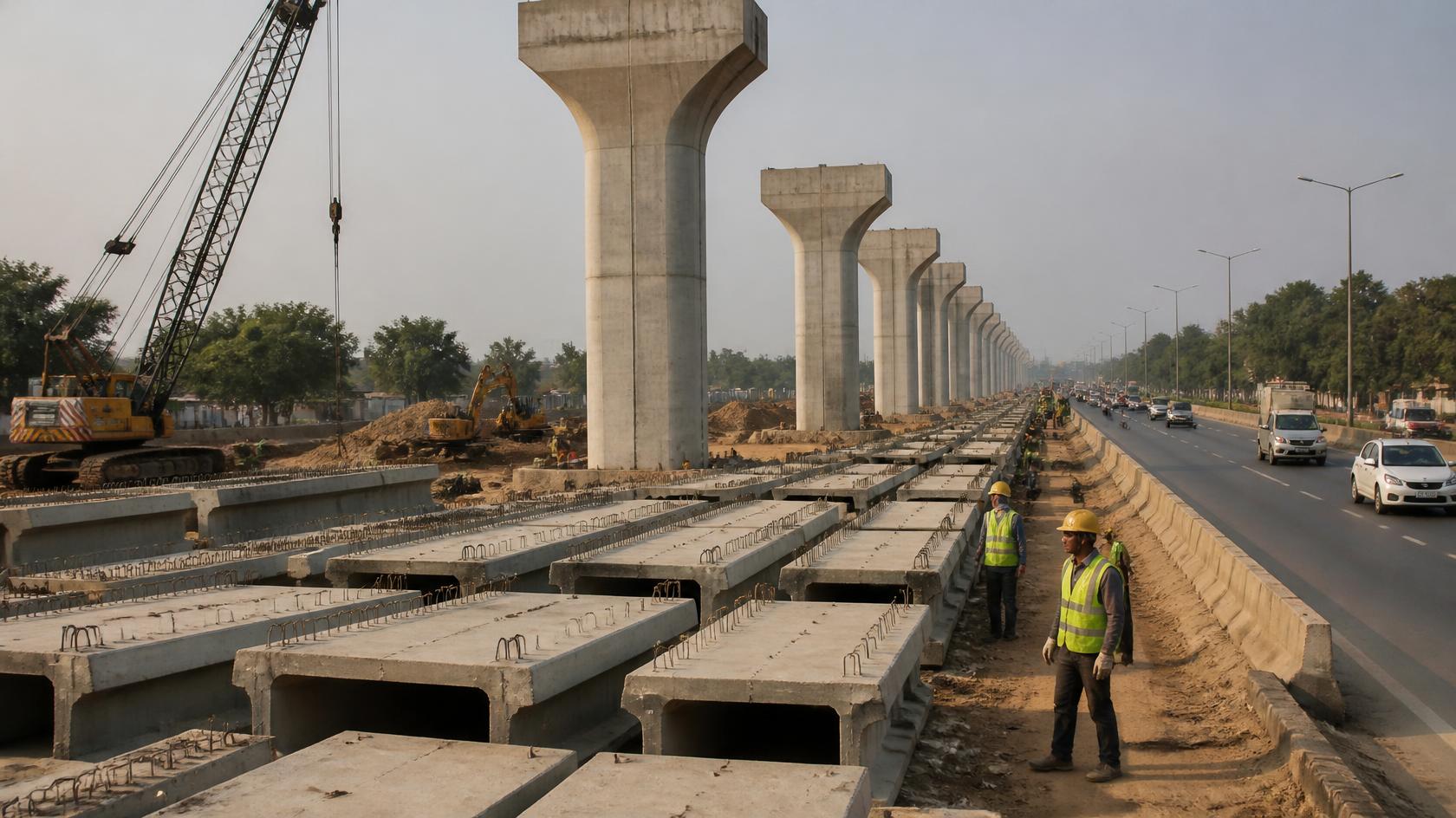
Indian per capita cement consumption is about 300 kg a year, against a global average of around 540 kg, per the same GCCA India–TERI release. As housing, infrastructure and urbanisation expand, that gap is expected to narrow. RMI notes that India produced about 400 million tonnes of cement in 2022, with demand projected to reach about 700 million tonnes by 2035. More cement means higher cement carbon emissions unless the carbon in each tonne falls quickly.
A relatively efficient starting point
Blended cements such as Portland Pozzolana Cement (made with fly ash) and Portland Slag Cement (made with blast-furnace slag) are already widely used in India. Even so, the cement industry emissions India reports remain large in absolute terms because of the sheer volume produced.
The industry's roadmap to 2070
In March 2025, GCCA India and TERI launched a decarbonisation roadmap targeting net-zero CO₂ for the Indian cement sector by 2070. As reported by CemNet, the roadmap projects average emission intensity falling from 0.68 t CO₂ per tonne of cement in 2020 to 0.56 t in 2030 and 0.51 t in 2047. The main levers include clinker substitution, alternative fuels, energy efficiency, renewable power and, in the longer term, carbon capture.
A worked example for builders
Here is an illustrative calculation, using the roadmap intensities above. A mid-sized residential project that uses 1,000 tonnes of cement would be associated with roughly 680 tonnes of CO₂ at the 2020 average intensity. At the 2030 target intensity, the same quantity would carry about 560 tonnes. That 120-tonne cut in cement carbon emissions comes from changes at the cement plant. A builder who also reduces the total cement used, or specifies a lower-carbon binder, can cut further. Actual figures depend on the specific cement, supplier and mix design.
Low-Carbon Cement Alternatives Builders Can Use Today
There is no single replacement for Portland cement. Instead, builders can reduce cement carbon emissions with a growing toolkit of options that reduce clinker, reduce cement, or replace the binder altogether. Each has trade-offs in availability, cost, curing and standards.
What is the most eco-friendly alternative to cement?
The honest answer is that it depends on the application, location and available supply chain. The main low-carbon cement alternatives in India today are:
Fly ash blends (PPC). Fly ash from coal power plants replaces part of the clinker. These cements are widely available and well understood by Indian contractors. Supply depends on proximity to thermal power plants.
Slag cements (PSC) and GGBS. Ground granulated blast-furnace slag, a steel-industry by-product, can replace a large share of clinker. Availability is strongest near steel-producing regions.
Limestone Calcined Clay Cement (LC3). LC3 combines clinker with calcined clay and limestone. RMI reports that it can cut emissions by up to 40% compared with ordinary Portland cement.
Alternative binders. Newer binders, including geopolymers and other non-calcined formulations, aim to avoid the limestone calcination step entirely. These are earlier in their market journey and need careful project-specific testing.
Is LC3 available in India?
Yes, though it is still scaling. India published a dedicated standard for LC3, IS 18189:2023, and commercial production has begun in parts of the country, according to RMI. RMI also flags real barriers: mix designs are still being developed, supply can be unreliable, ready-mix plants need new silos and quality-control processes, and LC3 did not yet have published EPDs at the time of its analysis.
Cement reduction: the overlooked lever
The lowest-carbon cement is the cement you do not use. Cutting volume is the most direct way to cut cement carbon emissions. Before switching products, look at how much binder a design really needs. Common cement-reduction strategies include:
Optimising concrete mix designs instead of over-specifying strength grades.
Choosing lighter walling systems that need less mortar and plaster.
Using precast elements made under controlled factory conditions, which reduces waste.
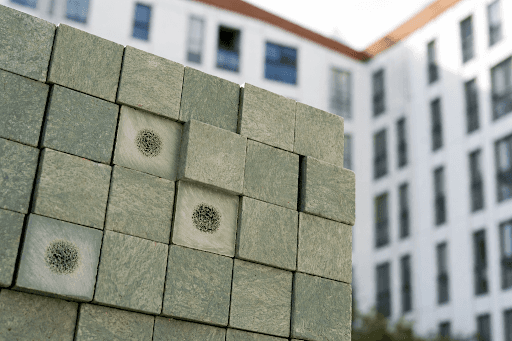
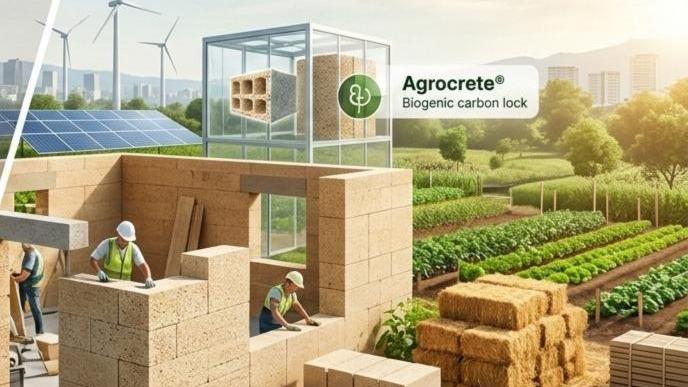
Specifying materials that store carbon, such as bio-based blocks, so the wall itself offsets part of the binder's footprint.
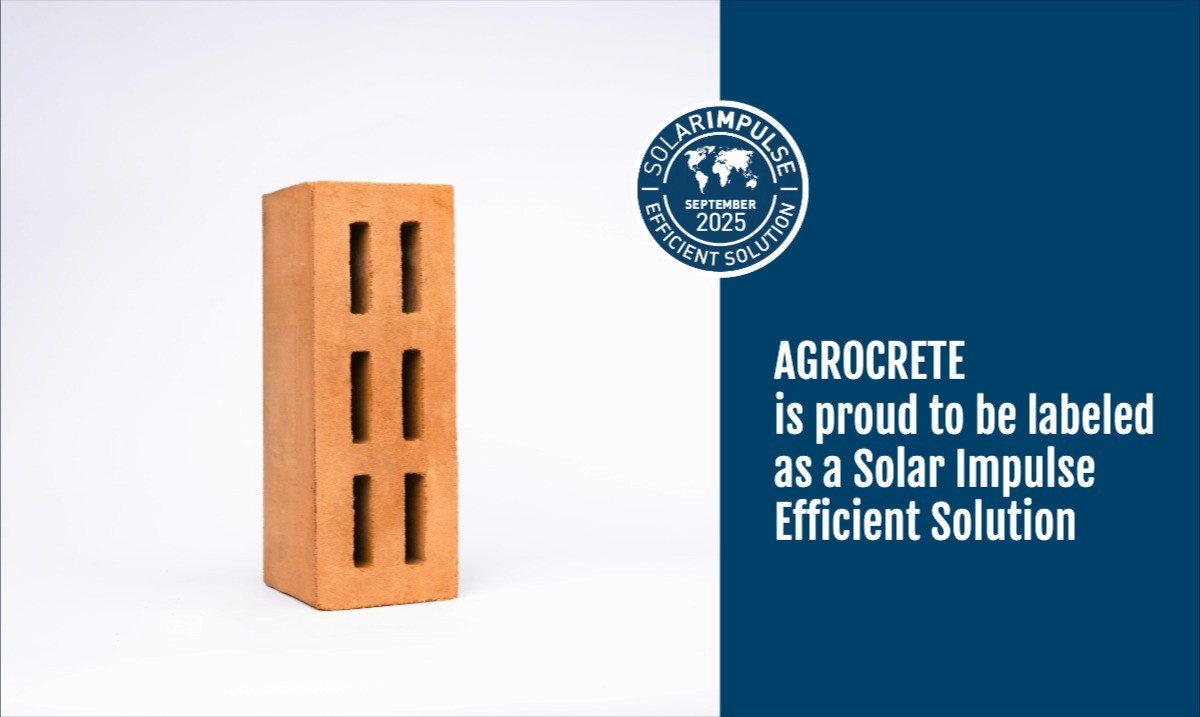
Walling is a good place to start. Our comparison of AAC blocks, red bricks and Agrocrete® shows how much the choice of masonry unit can change a building's embodied carbon.

How to Cut Cement Carbon Emissions on Your Next Project
Cement carbon emissions are a big problem, but they are not a fixed one. Builders control several decisions that move the numbers. Here is a practical sequence to follow.
1. Measure before you choose
You cannot manage cement carbon emissions you have not measured. Ask suppliers for EPDs or verified carbon data. Compare products per functional unit, for example per cubic metre of concrete at a required strength, not just per bag. Where data is missing, treat it as a risk, not as zero.
2. Use less, then use better
Reduce cement content through mix optimisation and efficient structural design first. Then specify blended cements or alternative binders where the engineering and standards allow. Always involve your structural engineer and concrete supplier before changing a specification.
3. Pilot new binders on the right elements
New binders are best introduced on lower-risk elements first, such as masonry mortar, plaster, non-structural blocks or paving. Test, document results and scale up once performance is proven on your sites.
4. Think in terms of the whole building
Cement is one part of a structure's footprint. Combining a lower-carbon binder with carbon-storing walling materials can shift a project's overall balance. Our explainer on climate-positive vs net zero explains how these targets differ.
Where BINDR™ fits
GreenJams developed BINDR™ as a low-carbon cement alternative for applications such as masonry, plastering, flooring and concrete. On its product page, GreenJams lists a manufacturer-declared footprint of 0.18 kg CO₂ per kg of binder, compared with 0.80–0.90 kg for OPC, and says it is made without a kiln or calcination. BINDR™ is not classified under the Indian OPC or PPC standards (IS 269, IS 8112 or IS 12269), so its suitability for any specific use needs project-specific validation by your engineer, and test reports are available on request. Results on site will vary with the application, mix and curing conditions.
Quick answers for busy builders
Can I cut cement emissions without changing suppliers? Often, yes. Switching from OPC to a blended cement your supplier already stocks, and optimising your mix, are low-disruption first steps.
Will low-carbon binders cost more? It varies. Prices depend on region and supply, so ask for comparative quotes and compare total installed cost, including curing time and labour.
What do I need from a supplier? Test reports against the relevant IS codes, an EPD or verified carbon figure, and clear guidance on mix ratios and curing.
Cement carbon emissions, and the construction industry's wider carbon challenge, will not be solved by one product. It will be solved by thousands of builders making better choices on every project, starting with how much cement they use and what kind. If you want to explore a lower-carbon binder for your next build, see BINDR™ specifications and request test reports.

Related posts
•
11 min
Read more
Sustainability
What Is Embodied Carbon in Buildings? A Practical Guide for India
What is embodied carbon in buildings? See how it differs from operational carbon, and how material choices in India cut upfront emissions. Start here.

•
4 min
Read more
Sustainability
Stone to Carbon-Negative: A History of Building Materials
A short history of building materials, from stone and timber to concrete, and the sustainable construction materials that now store more carbon.
•
4 min
Read more
Sustainability
The Circular Mandate: Circular Construction Future
Discover how circular construction turns industrial and agricultural waste into sustainable building materials, reducing resource depletion and emissions.
 Agrocrete® Blocks