Written By:
GreenJams
10 min
What Is Carbon-Negative Construction? How Can a Building Store More Carbon Than It Emits?

Carbon-negative construction sounds like a contradiction. Making cement, steel and fired bricks releases large amounts of carbon dioxide, and the World Green Building Council estimates that buildings account for 39% of global energy-related carbon emissions: 28% from running them and 11% from materials and construction. So how can anything we build store more carbon than it emits?
The short answer is that some building materials are made from plants that pulled CO₂ out of the air as they grew, and that carbon can stay locked inside a wall for decades. The longer answer depends on accounting: which life-cycle stages are counted, how stored carbon is treated, and whether a claim is about one kilogram of material or a whole building. This guide explains all three in plain English, using Agrocrete® as a worked example, so you can read any carbon-negative claim with confidence.
Tags:
Carbon Capture
Sustainability Manager
What is carbon-negative construction?
Carbon-negative construction is building in a way that removes or stores more carbon dioxide than the project emits, within a clearly stated boundary. If you add up every emission from making, transporting, building with and eventually disposing of the materials, then subtract the carbon those materials keep out of the atmosphere, the result is below zero.
That last phrase, within a clearly stated boundary, does most of the work. A product can be carbon-negative for the stages from raw material to factory gate while the building it goes into is still a net emitter. A building can be carbon-negative for its structure while its air conditioning burns grid electricity for fifty years. In carbon-negative construction, any honest claim names the boundary.
Carbon-negative vs carbon-neutral vs net zero
These terms get used interchangeably, but they mean different things:
Carbon-neutral or net zero: emissions are balanced to zero, often by buying offsets elsewhere. The building itself may still emit.
Carbon-negative: the net result is below zero, so the project leaves less CO₂ in the atmosphere than if it had not been built that way.
Climate-positive: often used as a marketing synonym for carbon-negative. We unpack the differences in Climate-Positive vs Net Zero: What's the Difference?
Why removal matters, not just reduction
Cutting emissions comes first. But the IPCC's Special Report on Global Warming of 1.5°C found that every pathway limiting warming to 1.5°C with limited or no overshoot also relies on carbon dioxide removal. Construction is one of the few industries that already handles millions of tonnes of material every year. If even part of that material stores carbon for the life of a building, the sector moves from being only a problem to being part of the removal answer.

How can a building material store more carbon than it emits?
Carbon-negative construction starts with materials. Carbon-negative building materials store carbon in one of two main ways: in plant matter (biogenic carbon) or in minerals. Most products sold as carbon-negative today rely on the first.
Biogenic carbon: carbon that plants took from the air
As a rice, wheat or hemp plant grows, photosynthesis turns atmospheric CO₂ into cellulose and other compounds. Each kilogram of carbon fixed this way removes about 3.67 kg of CO₂, because a CO₂ molecule weighs 44 units and a carbon atom 12. That stored carbon is called biogenic carbon.
What happens next decides the climate outcome. If crop residue rots, microbes slowly return its carbon to the air. If it is burned in the field, as paddy straw often is in north India, the carbon goes back in minutes. If it is bound into a durable material such as a block, board or panel, the carbon stays out of the atmosphere for as long as that material survives. We look at the farm side of this in Stubble Burning in India: Can Crop Waste Become a Building Material?
Mineral carbon: carbon bound into rock-like compounds
Some binders and concretes take up CO₂ chemically as they cure or carbonate, forming stable carbonates. This storage can be very long-lasting, but the amounts are usually small compared with the emissions of making cement in the first place. Using captured industrial CO₂ in a product is also not the same as removing CO₂ from the air.
The balance sheet
A material is carbon-negative only when its stored carbon outweighs everything it emits. The materials most often used in carbon-negative construction include:
Bio-aggregate blocks and concretes such as hempcrete and crop-residue blocks, where plant matter is bound in a mineral binder.
Timber and engineered wood, where results depend heavily on forestry practice and end-of-life treatment.
Straw, bamboo and other fibre-based panels and insulation.
In every case the binder matters. Lime and cement carry a large footprint of their own, so a bio-based block made with a high-carbon binder can easily end up carbon-positive. That is why GreenJams pairs crop residue with BINDR™, a cement-free, alkali-activated binder made mostly from industrial by-products.

Life-cycle boundaries: cradle-to-gate (A1–A3) vs whole-life carbon
Every credible carbon figure comes from a life-cycle assessment (LCA), and every LCA has a boundary. That boundary decides whether a carbon-negative construction claim holds up. Construction-product EPDs are commonly prepared to the European standard EN 15804, which splits a product's life into modules, including EPDs for Indian products published through international programmes. A closely aligned structure sits behind the international standard ISO 21930 for construction products.
Stage | Modules | What it covers |
|---|---|---|
Product | A1–A3 | Raw materials, transport to the factory, manufacturing |
Construction | A4–A5 | Transport to site, installation, site waste |
Use | B1–B7 | Maintenance, repair, replacement, operational energy and water |
End of life | C1–C4 | Demolition, transport, waste processing, disposal |
Beyond the system | D | Benefits and loads such as reuse, recycling or avoided burning, reported separately |
Cradle-to-gate (A1–A3)
Cradle-to-gate covers modules A1–A3 only: everything up to the moment a product leaves the factory. It is the most common figure on an Environmental Product Declaration (EPD) and the easiest to compare, but it says nothing about what happens on site or decades later.
Whole-life carbon
Whole-life carbon adds the construction, use and end-of-life stages for an entire building. The RICS professional standard Whole Life Carbon Assessment for the Built Environment (2nd edition), in effect since 1 July 2024, sets out how to do this consistently. A whole-life view is the only fair basis for calling a building carbon-negative, so it is the right yardstick for carbon-negative construction at project scale.
How biogenic carbon is counted
Under EN 15804+A2, carbon taken up by plants is shown as a negative number in A1–A3 and reported in its own indicator, GWP-biogenic. If the material is later burned or allowed to decompose, that carbon is shown as an emission in the end-of-life modules, so it balances out. The negative figure only "survives" over the whole life if the end-of-life scenario keeps the carbon stored, for example by recycling the material instead of incinerating it. This is why the EPD's end-of-life assumptions matter as much as its headline number.
For a wider primer on upfront and embodied emissions, read What Is Embodied Carbon in Buildings? A Practical Guide for India.

Case example: what Agrocrete®'s EPD shows, and what it doesn't
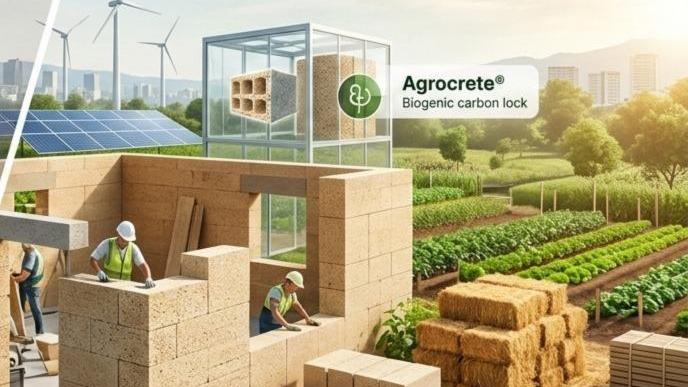
Agrocrete® is a useful case study in carbon-negative construction because its figures are public and independently checked. It is a block made from paddy straw, fly ash and ground slag, bound with an alkali-activated slag binder and cured without kiln firing. Its climate figures are declared in its third-party-verified EPD, registered with the International EPD® System as S-P-06876. The EPD follows ISO 14025 and EN 15804+A2 under PCR 2019:14, is valid until 20 October 2027, and reports results per 1 kg of moulded Agrocrete® mix.
Indicator, as declared in the EPD | Value per kg of mix |
|---|---|
GWP-fossil, A1–A3 | +0.307 kgCO₂e |
GWP-biogenic, A1–A3 | −0.439 kgCO₂e |
GWP-total, A1–A3 (cradle to gate) | −0.143 kgCO₂e |
GWP-total, C1–C4 (end of life) | +0.0096 kgCO₂e |
GWP-total, D (avoided straw burning, reported separately) | −0.018 kgCO₂e |
Reading the numbers
Cradle to gate, it is carbon-negative. The biogenic carbon stored in the straw (−0.439) outweighs the fossil emissions of making the mix (+0.307), giving −0.143 kgCO₂e per kg.
It stays negative at end of life. Adding modules C1–C4 gives about −0.133 kgCO₂e per kg, because the EPD's scenario assumes most demolished blocks are recycled rather than burned.
The avoided burning is a bonus, not part of the headline. EN 15804 keeps module D separate, so the −0.018 is not netted off.
Some stages were not assessed. Transport to site and construction (A4–A5) and the use stage (B1–B7) are outside the EPD's scope.
Worked example: one cubic metre of blockwork
The Agrocrete® catalogue declares a dry density of 800–1,000 kg/m³. Multiplying by −0.143 kgCO₂e/kg gives roughly 115–145 kg of CO₂e stored per cubic metre of solid block, cradle to gate. That is an estimate for the block alone. Mortar, plaster and transport to site would need to be added from their own data before you could speak about a wall.
The lesson for carbon-negative construction is that storage per kilogram is modest. Agrocrete®'s larger benefit is often what it replaces: a high-carbon fired brick or cement block. For the full verified data and how it was prepared, see World's First Verified Carbon-Negative Construction Block.

Can a whole building be carbon-negative in India?
It is possible, but it is hard. Carbon-negative construction at building scale needs more than one good product: a carbon-negative material does not automatically make a carbon-negative building. A typical Indian building also contains a concrete frame, steel reinforcement, glass, finishes and services, most of which are carbon-intensive. Then it uses electricity for decades. For carbon-negative buildings in India to become common, the stored carbon in walls, panels and insulation would need to outweigh all of that across the whole life, not only at the factory gate.
The realistic path for most projects is to treat carbon-negative construction as a direction of travel rather than a label:
Measure first. Run a whole-life carbon assessment early, while design choices are still cheap to change.
Cut the big items. Reduce cement and steel through efficient structural design and lower-carbon binders.
Store where you can. Use bio-based walling and insulation in place of fired bricks and foams.
Design for a long life and recovery. Stored carbon only counts while it stays stored, so plan for reuse and recycling at end of life.
Run on clean energy. Passive cooling and renewable power keep operational emissions from cancelling out the gains.
How to check a carbon-negative claim
Before you rely on any carbon-negative claim, from us or anyone else, ask five questions:
Is there a third-party-verified EPD registered with a recognised programme operator?
Which modules does it cover? A1–A3 only, or C1–C4 as well?
Which indicator is quoted? GWP-total includes biogenic carbon; GWP-fossil and GWP-GHG do not.
What is the declared unit? Per kilogram, per block and per square metre of wall give very different numbers.
What happens at end of life? If the scenario assumes burning or decay, the stored carbon is released.
Frequently asked questions
Is carbon-negative construction the same as net zero?
No. Net zero balances emissions to zero, often with offsets. Carbon-negative construction aims for a result below zero, with the stored or removed carbon counted inside the project's own boundary.
What are examples of carbon-negative building materials?
Crop-residue blocks such as Agrocrete®, hempcrete, some timber and engineered-wood products, and straw or fibre-based panels can be carbon-negative. Each one depends on its binder, its process energy and its end-of-life scenario, so check the EPD rather than the material category.
Does using a carbon-negative material make my building carbon-negative?
Not on its own. It lowers the building's embodied carbon, but the frame, finishes, construction activity and decades of energy use still count in a whole-life assessment.
How long does the stored carbon stay out of the atmosphere?
For as long as the material survives without burning or decaying. Long building lives, good maintenance and recycling at end of life all help carbon-negative construction deliver what it promises.
See the data for yourself
Transparent accounting is what turns carbon-negative construction from a slogan into something a sustainability manager can put in a report. Agrocrete®'s figures are public, verified and bounded. Read the Agrocrete® impact data, or download the full EPD (PDF) and check the modules yourself.

 Agrocrete® Blocks