Written By:
GreenJams
10 min
How to Calculate the Embodied Carbon of a Building: A Beginner's Guide

You cannot cut what you have not counted. As clients, lenders and green-rating systems start asking about upfront emissions, more Indian project teams want to run an embodied carbon calculation themselves, early enough to change the design. The good news is that the core method is simple: multiply the quantity of each material by an emission factor, then add up the results.
The hard part is doing it consistently. This beginner's guide shows how to calculate embodied carbon for a building step by step: set the boundary, take off quantities, choose emission factors, work through an example and use Environmental Product Declarations (EPDs) to improve your data. If you need a refresher on what embodied carbon is, start with our practical guide to embodied carbon in India, then come back here for the maths.
Tags:
Carbon Capture
Sustainability Manager
Step 1: Set the Scope and System Boundary for Your Embodied Carbon Calculation
Embodied carbon is the greenhouse gas emitted to make, transport, install, maintain and finally dispose of a building's materials, reported in kilograms of CO₂ equivalent (kgCO₂e). Before you count anything, decide which part of that life you are counting. Most methods use the life-cycle modules defined in the European standards EN 15978 (for buildings) and EN 15804 (for construction products):
A1–A3, product stage: raw material supply, transport to the factory and manufacturing. This is "cradle to gate".
A4–A5, construction stage: transport to site, and installation, including site energy and wasted material.
B1–B7, use stage: maintenance, repair, replacement and refurbishment (B1–B5), plus operational energy and water (B6–B7), which are usually reported as operational carbon.
C1–C4, end of life: demolition, transport, waste processing and disposal.
Module D: benefits and loads beyond the system boundary, such as future recycling, always reported separately.
Which boundary should a beginner use?
Start with A1–A5, "cradle to practical completion". The Institution of Structural Engineers (IStructE) calls this the minimum scope for an embodied carbon calculation of a building's sub- and superstructure in its brief guide to calculating embodied carbon (The Structural Engineer, July 2020). It also identifies A1–A3 as the largest contributor. Once you are comfortable, extend to the full life cycle following the RICS Whole Life Carbon Assessment standard (2nd edition, effective July 2024), which now applies globally.
Decide what you are measuring
Building elements: substructure, frame, floors, walls, roof, finishes and services. Beginners often start with structure and envelope, which carry most of the mass.
Reference unit: report the total and the intensity per square metre of floor area, so that design options can be compared.
Reference study period: if you go beyond A5, state the assumed building life, often 50 or 60 years.
Write these choices down. They are the foundation of any credible building life-cycle assessment in India, and two calculations of the same building can differ widely simply because they used different boundaries.

Step 2: Collect Material Quantities
Quantities are the first half of every embodied carbon calculation. You need the mass of each material, because most emission factors are expressed in kgCO₂e per kilogram.
Where to get quantities
Concept stage: estimate from rules of thumb, typical member sizes or a similar past project. IStructE advises engineers not to be deterred by early uncertainty, but to recognise its limits.
Design development: export volumes from the structural model or the building information model (BIM).
Tender and construction: use the bill of quantities, then purchase and delivery records for an as-built figure.
Convert everything to mass
Multiply volume by density. Reinforced concrete is commonly taken at about 2,400 kg/m³, as in the IStructE worked example. Reinforcement is often estimated in kilograms per cubic metre of concrete until the detailing is done. For blocks, boards and insulation, use the density from the product's data sheet or EPD, because these vary widely between products.
Tips that save rework
Set up a spreadsheet with one row per material and columns for quantity, unit, density, mass and each life-cycle module.
Keep concrete and reinforcement on separate rows. Their factors are very different.
Record sources and assumptions in a notes column. A reviewer will ask for them.
Group rows by building element so you can see where the carbon sits, not just how much there is.
Do not forget the small items that add up across a whole building: mortar, plaster, screeds and waterproofing.
Step 3: Choose Emission Factors (EPDs vs Generic Databases)
The emission factor, which IStructE calls the embodied carbon factor (ECF), is the second half of the equation. It tells you how much CO₂e is emitted per kilogram of a material for a given set of modules. Choosing factors well is the biggest quality lever in any embodied carbon calculation.
Option 1: generic databases
Generic factors represent an average product. The best known is the Inventory of Carbon and Energy (ICE) database, a free dataset from Circular Ecology that is updated periodically, so check which version you are using. For India, IFC's EDGE programme published an India Construction Materials Database (methodology report, 2017) of embodied energy and global warming potential for around 100 building products used in India. Generic data is ideal at concept stage, before you know the supplier.
Option 2: Environmental Product Declarations
An environmental product declaration in construction is an independently verified report of a specific product's life-cycle impacts, prepared under ISO 14025 and, for construction products, EN 15804. Programmes such as the International EPD® System, which has an Indian regional hub, publish them. Because an EPD reflects one manufacturer's actual raw materials, energy and process, it is more accurate than an average once you know what you are buying.
How much do factors vary?
A lot. In IStructE's guide, the A1–A3 factor for rebar ranges from 0.684 kgCO₂e/kg for UK-produced bar (manufacturer EPD) to closer to 2.1 kgCO₂e/kg for a bar with no recycled content produced elsewhere. Concrete factors fall as cement replacement rises: 0.120 kgCO₂e/kg for C32/40 concrete with 25% GGBS, but 0.063 kgCO₂e/kg with 75% GGBS (ICE V3 values quoted in the guide). The same material name can hide a several-fold difference, which is why cement content matters so much, as we explained in how cement contributes to global warming.
Where can I find emission factors for Indian materials?
Start with supplier EPDs for the products you are likely to buy. Fill gaps with India-specific data where it exists, such as the EDGE India database, and use international databases as a last resort. Indian cement blends, grid electricity and haulage distances differ from European averages, so flag every borrowed factor as an assumption in your notes.
Step 4: A Worked Embodied Carbon Calculation for a Floor Slab
Here is a simplified embodied carbon calculation for a 100 m² ground-floor slab, 150 mm thick. It is illustrative only: the factors are generic values published in the IStructE guide (mostly UK and ICE V3 data, 2020), not Indian project data. For a real project, swap in your own quantities and your suppliers' EPDs.
Inputs
Concrete: 100 m² × 0.15 m = 15 m³. At 2,400 kg/m³, that is 36,000 kg.
Rebar: assumed at 90 kg per m³ of concrete, as in the IStructE example, so 1,350 kg.
A1–A3 factors: concrete C32/40 with 25% GGBS at 0.120 kgCO₂e/kg; rebar at the world-average value of 1.99 kgCO₂e/kg (both ICE V3, as quoted by IStructE).
A4 transport: road freight at 0.1065 gCO₂e per kg per km (UK BEIS 2020 factor, quoted by IStructE). Assume concrete travels 30 km and rebar 300 km.
A5 waste: IStructE's waste factor of 0.053 (a 5% waste rate) for both in-situ concrete and rebar, applied to the A1–A3 and A4 factors plus its default end-of-life allowances of 0.005 (C2) and 0.013 (C3–C4) kgCO₂e/kg.
Calculation: quantity × emission factor = kgCO₂e
Concrete A1–A3: 36,000 × 0.120 = 4,320 kgCO₂e
Concrete A4: 36,000 × 30 km × 0.0001065 = 115 kgCO₂e
Concrete A5 waste: 0.053 × (0.120 + 0.0032 + 0.005 + 0.013) = 0.0075 kgCO₂e/kg; × 36,000 = 269 kgCO₂e
Rebar A1–A3: 1,350 × 1.99 = 2,687 kgCO₂e
Rebar A4: 1,350 × 300 km × 0.0001065 = 43 kgCO₂e
Rebar A5 waste: 0.053 × (1.99 + 0.032 + 0.005 + 0.013) = 0.108 kgCO₂e/kg; × 1,350 = 146 kgCO₂e
Result
Total A1–A5, excluding site energy (A5a): about 7,580 kgCO₂e, or 7.6 tonnes. That is roughly 76 kgCO₂e per m² of slab.
Two lessons stand out. First, A1–A3 makes up about 92% of the total, so material choice dominates. Second, rebar is under 4% of the mass but about 38% of the carbon. Optimising reinforcement and choosing lower-carbon steel and concrete mixes will usually pay off far more than shaving transport kilometres.
What about site energy?
To complete A5, add emissions from diesel and electricity used on site (A5a). IStructE recommends monitoring these during construction. Its default allowance is based on UK construction costs, so it does not translate directly to Indian projects; use metered site data or records from a comparable past project instead.

Step 5: Use EPDs Well and Avoid Common Calculation Mistakes
EPDs are the best way to move from an average estimate to a project-specific one. But they are technical documents, and they are easy to misread.
How to read an EPD in five checks
Declared unit. Is the result per kg, per m³, per m² or per block? Convert it to match your quantities.
Modules declared. Which of A1–A3, A4–A5, B, C and D are included? Never compare a cradle-to-gate figure with a cradle-to-grave one.
Indicator. Under EN 15804+A2, GWP-total includes biogenic carbon, while GWP-fossil and GWP-GHG leave out stored biogenic carbon. Use the same indicator for every material in your total.
Verification and validity. Look for independent third-party verification and check the validity date.
Geography. An EPD for a plant in another country may not reflect the product delivered to your site.
An EPD in practice
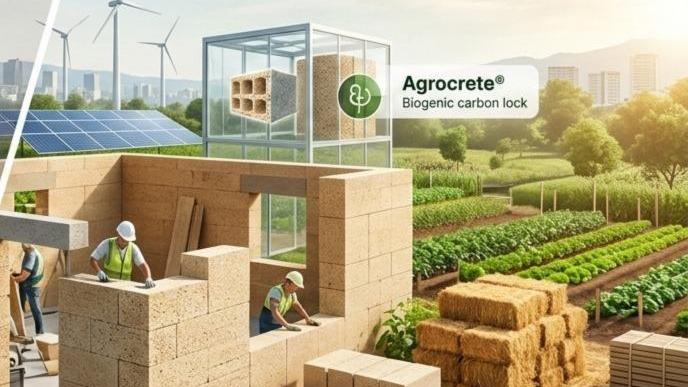
Take our own product as an example. Agrocrete®'s third-party-verified EPD (S-P-06876, International EPD® System) declares results per kg of moulded mix for modules A1–A3, C1–C4 and D; modules A4, A5 and B were not assessed. Its A1–A3 GWP-total is −0.143 kgCO₂e/kg, because of biogenic carbon stored in the paddy straw. Excluding that biogenic carbon, its GWP-GHG figure is 0.307 kgCO₂e/kg. To use it, multiply the mass of blocks by the factor for the modules you are reporting, add your own A4 transport, and keep biogenic storage visible rather than netting it off silently. We explain where that stored carbon comes from in how agricultural waste building materials can cut a building's footprint.
Common mistakes to avoid
Mixing boundaries across materials in one total.
Adding module D benefits into the A1–A3 result instead of reporting them separately.
Unit mismatches, such as applying a per-m³ factor to a mass in kilograms.
Dropping small items like reinforcement, mortar and plaster.
Claiming a carbon-negative building because one material is carbon-negative. A carbon-negative block lowers a building's total; it does not make the whole building carbon-negative.
FAQ: is there software to calculate embodied carbon?
Yes. Whole-building LCA tools automate the factors and modules, and IFC's EDGE app includes a materials module. A spreadsheet is still the best way to learn the method and to sanity-check any tool's output.
The bottom line
An embodied carbon calculation for a building comes down to quantity × emission factor, repeated carefully inside a clear boundary. Start at concept stage with generic data, replace it with EPDs as suppliers are chosen, and publish your assumptions alongside the result.
Need verified data for your project's walls? Request product environmental data from GreenJams, including our EPD.

Related posts
•
10 min
Read more
Carbon Capture
What Is Carbon-Negative Construction? How Can a Building Store More Carbon Than It Emits?
Carbon-negative construction explained: how materials store carbon, what A1–A3 and whole-life boundaries mean, and how to test a claim before you trust it.

•
4 min
Read more
Carbon Capture
Climate-Positive Construction: The Carbon Counter-Attack
Climate-positive construction explained: how carbon-storing materials like Agrocrete® turn buildings into carbon stores, with a 2.6 km case study.
 Agrocrete® spec sheet (PDF)