Written By:
Tarun Jami
4 min
The Empire State Could've Stored Up to 1,600 t of CO₂

The Empire State Building is one of the most iconic structures in the world. It stood the test of time and defied many odds right from its inception. Built during the Depression in 1930–31, it held the title of the world's tallest building for 41 years, until the World Trade Center claimed it in 1972. At 1,250 ft, it is less than half the height of today's tallest building, the Burj Khalifa, and yet it remains one of the world's most popular buildings.
It was also built in a record one year and 45 days by 3,000 workers, working Sundays and holidays. It contains about 54,000 tonnes of steel, 5,600 m³ of Indiana limestone and granite, 660 tonnes of aluminium and stainless steel, and a whopping 10 million bricks, according to PBS. It was never going to be the greenest of buildings. Making that much steel today, at the global average of 1.92 tonnes of CO₂ per tonne reported by worldsteel, would emit roughly 104,000 tonnes of CO₂.
Tags:
Sustainability
A white elephant, and an energy-hungry one
The Empire State also holds another distinction: it is one of the world's great white elephants. According to the New York Times, it failed to turn a profit until 1950, simply because it couldn't convince enough tenants to occupy its offices. The Great Depression and World War II were to blame as well. Even in the 2000s, it struggled to compete with the sleeker skyscrapers redefining New York's skyline.
Today its most valuable assets are the observation decks, which attract around 4 million visitors a year. But in today's context it is a white elephant for a different reason: it is not exactly energy efficient. In 2009, the annual electricity bill was a mind-boggling US$11 million. Even after a retrofit to improve its efficiency, it still costs at least US$7 million a year to power, which brings us to the question...
What if the Empire State was built using Agrocrete®?
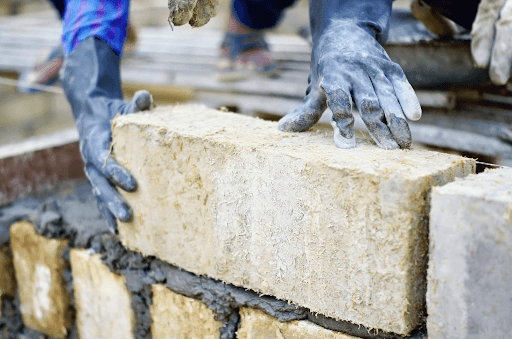
First, a disclaimer: we are not saying the entire building could be built with Agrocrete®. Its steel frame would still be needed. But as a replacement for the 10 million clay bricks, Agrocrete® blocks would have cut the building's carbon footprint and its running costs, goals the current owner of the Empire State is actively pursuing.
Recalculating the headline with our verified EPD
When we first ran these numbers in 2017, we estimated that swapping the bricks for Agrocrete® would have captured almost 2,900 tonnes of CO₂, which our headline rounded up to 3,000. Since then, Agrocrete® has gained a third-party verified Environmental Product Declaration (EPD). So we have redone the sums with the EPD's figure and an explicit wall volume. The answer is lower.
The method is simple: wall material mass × EPD factor. Here is each step.
Step | Working | Result |
|---|---|---|
1. Bricks in the building | 10,000,000 bricks (PBS) | 10,000,000 |
2. Volume of one common brick | 2¼ × 8 × 3¾ in = 67.5 in³ (Engineering ToolBox) | 0.00111 m³ |
3. Total brick volume (mortar excluded) | 10,000,000 × 0.00111 m³ | ≈ 11,060 m³ |
4. Agrocrete® mass for the same volume | 11,060 m³ × 800–1,000 kg/m³ dry density (manufacturer-declared, Agrocrete® catalogue) | 8,850–11,060 t |
5. Carbon stored, cradle to gate | 8,850,000–11,060,000 kg × 0.143 kgCO₂e/kg (EPD, A1–A3) | ≈ 1,270–1,580 t CO₂e |
Two checks support that range. Adding the EPD's end-of-life modules (C1–C4, +0.0096 kgCO₂e per kg) trims it to about 1,180–1,470 tonnes. And our Kapurthala perimeter wall stores 38.5 tonnes of CO₂ in about 350 m³ of blockwork, or 0.11 tonnes per m³. Applied to 11,060 m³, that gives about 1,220 tonnes, inside the same range.
So the honest headline is up to about 1,600 tonnes, not 3,000. Our 2017 figure appears to have assumed Agrocrete® would replace the bricks kilo for kilo. Agrocrete® is much less dense than fired clay (800–1,000 kg/m³ against 1,800–2,000 kg/m³ for red brick in GreenJams' catalogue comparison), so the same wall uses less material by weight, and stores less carbon in total. The bricks' own kiln emissions would still have been avoided, offsetting a small part of the footprint of the steel. And Agrocrete® has another trick up its sleeve.
Thermal insulation
Before the energy-efficiency retrofit that began in 2009, the 2.7 million sq ft building used almost 26 kWh per sq ft each year, partly because solid clay-brick walls are poor insulators. The retrofit, at a total cost of around US$106 million, was projected by Rocky Mountain Institute to cut energy use by about 38%, to roughly 17.5 kWh per sq ft.
Our 2017 model estimated that, had the original builders used Agrocrete® blocks instead of clay bricks (had Agrocrete® existed in 1931, of course!), energy demand would have been about 25% lower than the clay-brick base case. Per the GreenJams product catalogue, Agrocrete® walls give 3.5 times better thermal insulation than conventional walls (manufacturer-declared), so far less heat passes through them.
Now, what does that mean?
In that model, a pre-retrofit Empire State built with Agrocrete® would have used about 19.5 kWh per sq ft, or roughly 17.5 million kWh less each year. By our 2017 estimate, that is about 7,000 tonnes less CO₂ every year, which over the building's life would far outweigh the carbon stored in its walls. These operational figures come from our own modelling and have not been independently verified.
Alas, there isn't much we can change about the past. But imagine the impact we could create if every new building on this planet were built with Agrocrete®. To see why we call it a weapon in the war against climate change, start with how it turns crop residue into walls.
Planning a building of your own? Get a sample of Agrocrete®, or browse the Agrocrete® catalogue for solid and hollow block specifications.
Related posts
•
12 min
Read more
Sustainability
Sustainable Building Materials in India: 10 Alternatives to Conventional Construction
Sustainable building materials India builders can use today: 10 lower-carbon alternatives, where each fits, and what test data to ask for first.

•
10 min
Read more
Sustainability
How to Keep Your House Cool in Indian Summers Without Relying Only on AC
Keep house cool in summer, India-style: roof and wall insulation, shading, cross-ventilation and smart orientation. See which fixes to make first.

•
9 min
Read more
Sustainability
Stubble Burning in India: Can Crop Waste Become a Building Material?
Looking for a stubble burning solution India can scale? See how paddy straw can become a building material, and what still stands in the way.

 Agrocrete® spec sheet (PDF)